

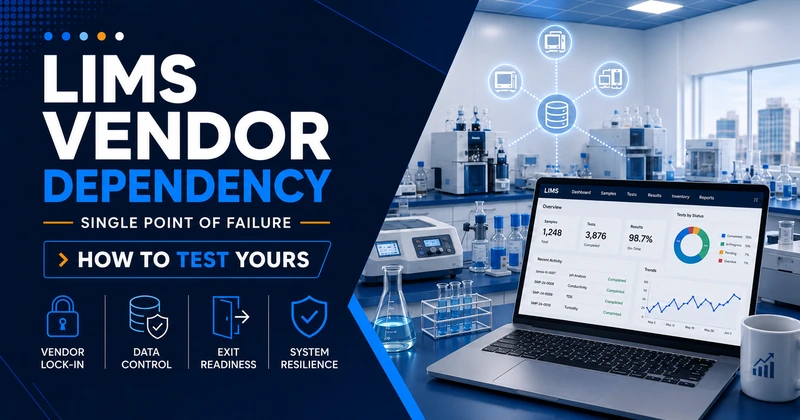
It is Monday morning, and your inbox has an email from your software vendor.
Nothing dramatic. A support ticket that used to close in three days now says “in progress” for the second week in a row. A pricing renewal that jumped without much explanation. A key contact who used to answer in an hour and now takes two days. Maybe the vendor was just acquired. Maybe their best engineer left. Maybe your account just isn’t the priority it used to be.
Nothing breaks. Orders still come in. Samples still get logged. Analysts still enter results. Reports still go out. Invoices still get generated.
On the surface, everything looks fine.
Then ask yourself a more specific question – not “is our vendor good,” but “if their responsiveness dropped starting today, could we still keep the five things this laboratory actually runs on moving: samples, results, reports, QA, and billing?”
Most laboratory leaders answer that instinctively. “Yes, of course.”
Fewer can answer it with evidence.
That gap, between confidence and evidence, is the real risk. And it is worth closing before a vendor slowdown forces the question.
- why “vendor slowdown” is more common than a dramatic vendor failure
- the five workflows that stall first when vendor responsiveness drops
- a 15-minute way to stress test each one
- the warning signs that show up before it becomes an emergency
- an 8-point Laboratory Vendor Continuity Checklist
- how a real environmental testing laboratory kept every workflow moving during a vendor transition, with zero downtime
Quick Takeaway for Laboratory Leaders
If your laboratory runs on a LIMS, an internal platform, or a vendor-built system, vendor responsiveness is a single point of failure, the same way an instrument, a network link, or a key employee is. You do not need to distrust your vendor to plan for this. You just need to accept that vendors get acquired, reprioritize, lose key staff, or slow down for reasons that have nothing to do with how much your laboratory depends on them.
The five workflows to protect are the ones that keep a laboratory running day to day:
This Article Is for You If
This is relevant if your laboratory:
- runs on a vendor-supported LIMS, internal platform, or hybrid desktop/web system
- relies on one vendor, or one contact at that vendor, as the center of gravity for changes
- has watched support ticket response times get longer over the past year
- does not have an internal, documented view of the database, workflow logic, or release process
- has never actually tested what happens if the vendor goes quiet for a month
- is weighing whether to renew, replace, or build internal capability alongside the current system
A Vendor Does Not Have to Disappear to Become a Risk
“Vendor slowdown” sounds dramatic, but it rarely arrives as a single event. It shows up quietly, in small changes that are each easy to explain away:
- support tickets take longer to close than they used to
- pricing goes up while responsiveness goes down
- staff at the vendor turn over, and the new team does not have the same history with your system
- the vendor gets acquired, and your product line is no longer the roadmap priority
- your requests sit behind larger clients with bigger contracts
- the vendor quietly stops investing in a platform they view as mature or legacy
None of this means your vendor is doing anything wrong. Vendors have limited capacity, competing priorities, and their own business pressures, exactly like you do. But if your laboratory’s ability to keep operating depends entirely on their capacity, that is your risk to manage, not theirs.
The Five Things That Have to Keep Moving
For a laboratory, “keep the business moving” is not abstract. It comes down to five workflows, and each one has a different failure mode when vendor responsiveness slows.
| Workflow | What “Still Moving” Looks Like | What Stalls First Under a Vendor Slowdown |
|---|---|---|
| Samples | Orders are created, chain of custody is logged, samples are distributed to the right analysts. | Sample routing or distribution logic breaks and sits in a ticket queue. |
| Results | Analysts enter results into the correct forms for each analysis type. | An analysis code needs updating, or a data-entry bug blocks a whole department. |
| Reports | Clients receive accurate, on-time reports in the format they expect. | A report template fix or a new client field takes weeks instead of days. |
| QA | Results are reviewed, amended, and defensible under audit. | QA logic is opaque, and workflow changes need vendor sign-off you cannot get quickly. |
| Billing | Pricing is applied correctly, and invoices go out on schedule. | Pricing logic lives with the vendor, and billing errors go uncorrected for a cycle. |
Samples
Orders come in, chain of custody gets logged, samples move through intake and get distributed to analysts. If the only person who understands how sample distribution or batch assignment actually works sits at your vendor, a routing bug or a duplicate-sample issue waits for their availability, not yours.
Results
Analysts enter results into forms specific to each analysis type. If a form breaks, or a new analysis code needs to be added, and only the vendor can touch that logic, data entry stalls, and everything downstream of it stalls with it.
Reports
Clients expect reports on time. Regulatory turnaround windows do not pause for a vendor’s backlog. If a report template needs a fix, or a client wants a new field, and that takes three weeks instead of three days, your client relationship absorbs the delay, not the vendor’s.
QA
QA and QC review, amendments, and audit trails are what make laboratory results defensible. If QA workflow logic is not something your team can adjust or even fully explain, you are relying on the vendor’s availability to protect the credibility of your results.
Billing
Revenue does not wait for a support ticket. If pricing logic, customer-specific rates, or invoice generation live entirely inside vendor-controlled code, a slow vendor response shows up directly on your books, not just in your operations.
The 15-Minute Stress Test
You do not need a formal audit to get a first read on this. For each of the five workflows above, ask three questions:
Could someone other than the vendor make a small, safe change here this week?
Do we have documentation that a new person, on our team or a new vendor’s, could actually follow?
If the vendor did not respond for 30 days, what would break first?
The 8-Point Laboratory Vendor Continuity Checklist
Before you assume you are covered, check these eight areas.
Response Time Baseline
How long does a normal support ticket take today, and has that number been trending up over the last six to twelve months?
Single Point of Contact
Is there one person, at the vendor or on your team, who “just knows” how a critical workflow works, with nothing written down?
Documentation Reality Check
Could a new engineer, from your team or a different vendor, ramp up on your system from what is actually documented?
Database Ownership
Do you have your own visibility into the database structure, or does every schema question go through the vendor?
Change Request Backlog
How many pending requests are sitting with your vendor right now, and how long has the oldest one been waiting?
Emergency Path
If something broke in production today, who fixes it, and how fast, realistically, not contractually?
Contract Leverage
Does your contract give you rights to source code, data exports, and documentation if the relationship changes or ends?
Internal Capability
Does anyone in-house understand enough of the system to keep samples, results, reports, QA, and billing moving for a month without the vendor?
What This Looked Like for One Laboratory
We saw this pattern clearly while supporting a US environmental testing laboratory running a mission-critical hybrid LIMS: mature desktop workflows, a growing API layer, a web frontend, and a shared SQL Server database underneath all of it.
Rather than wait for a vendor slowdown to become a crisis, the laboratory brought in a second engineering team to build parallel capability, not to replace the existing vendor relationship, but to make sure it was not the only path forward.
That work included:
- documenting the existing workflows and database structure that had never been fully written down
- taking ownership of specific enhancement requests instead of routing everything through one channel
- modernizing a specific workflow, PLM result entry, to the web without touching or replacing the core LIMS
- keeping the mature desktop system stable and fully operational throughout the entire engagement
- establishing a second, capable point of engineering support so the laboratory was no longer dependent on any single team’s bandwidth
Building Continuity Does Not Mean Replacing Your Vendor
Nothing about this requires firing your current vendor or replacing your LIMS. Continuity means:
That is a materially different position than hoping your current vendor never slows down.
Before Tomorrow Comes
Ask the direct version of the question this article opened with:
- If our vendor got slower starting today, what is the first workflow that stops?
- How long could we keep running on what we already know how to do ourselves?
- Who else, besides the vendor, actually understands this system well enough to keep it moving?
If the honest answer is “we are not sure,” that is a useful answer. It just means the stress test has not been run yet.