
58.1 billion euros! Big number, right?
Well, that’s how much Germany’s software market is expected to earn in 2026.
Impressive, isn’t it?
But here’s the catch.
A lot of software never turns into anything usable. Large IT projects run 45 percent over budget on average.
And compliance?
70 percent of German companies have dropped innovation plans at least once because of data protection rules.
But partnering with the top software development companies in Germany can change the game here.
Now, how do you pick the right one?
Well, look beyond the pitch.
Check their experience and certifications. Ask where your data will live. Match their technology stack to your build.
Sounds like a lot of work, right?
We’ve done it for you.
Here are the 20 best software development firms in Germany. Your next development partner could be one of them.
Key Takeaways
- Germany’s software market is set to grow 9.9% to €58.1 billion in 2026 (Bitkom). Spending on AI platforms is growing even faster, by about 76%.
- Germany is short about 79,000 IT specialists, and 78% of companies feel the shortage (Bitkom, September 2026).
- A senior software developer in Germany earns a median of €65,100 a year (Stepstone). A German freelancer asks a median of €90 an hour. Senior offshore developers in Asia cost about $31 to $41 an hour.
- Cyberattacks cost German businesses between €160 billion and €206 billion a year (Bitkom, 2026). Security has to be part of the build from day one.
- New rules raise the bar. The accessibility law BFSG has applied since June 2025, and the NIS2 security law now covers about 29,500 German companies.
- 19 of the 20 firms on this list have a German address. But some are small sales offices. Ask where the engineers who build your product actually sit.
Editorial Disclosure
Brain Station 23This is a well-researched listicle by the Brain Station 23 team. And yes, we included ourselves on this list, so please keep that in mind as you read.
Also note that nobody paid for a spot or a rank, and no company saw the draft before we published it.
If another firm on this list is a better fit for your build, hire them. Just choose wisely. A bad development partner can cost you time, money, and even your project.
List of the Top 20 Software Development Companies in Germany – An Overview
| Rank | Company | Founded | German Office / Headquarters | Team Size (Company-Stated) | Core Services | Industry Specialization | Tech Stack / Expertise | Certifications & Partnerships | Engagement Models | Ideal For |
|---|---|---|---|---|---|---|---|---|---|---|
| 1 | Brain Station 23 | 2006 | Bad Zwischenahn, Germany (Brain Station 23 GmbH). HQ: Dhaka, Bangladesh. | 900+ | Custom software; Web & mobile apps; Staff augmentation; Managed services; MVP development; Digital transformation; Technology consulting; ML & AI; Data engineering & BI; LMS (Moodle) & proctoring; eCommerce; ERP; Cloud & DevOps; Cyber security; Blockchain; QA & automation; AEM & SharePoint | Fintech; Pharma; Telecom; Real Estate; Software/ITES; e-Commerce; Education; Retail; Automotive; Banking/NBFI; Manufacturing; Startup; Non-Profit | React; Angular; Vue.js; Node.js; .NET; C#; Java; Python; Laravel; PHP; Flutter; iOS; Android; Golang; Moodle; AWS & Azure; AEM; Sitecore; Odoo; AI/ML; AR/VR; Blockchain | CMMI Level 3, ISO 9001, ISO 27001, SOC 2 Type II. Partner: AWS, Microsoft, Google Cloud, Salesforce, Odoo, Atlassian, Moodle | Staff augmentation; Managed services; Dedicated teams; MVP fixed-scope; Digital transformation; Solution partner | Enterprises and SMEs wanting a DACH-facing partner with offshore scale and full compliance |
| 2 | *instinctools | 2000 | Stuttgart, Germany (EU HQ). US HQ: Potomac, Maryland, USA. | 400+ | Digital transformation, cloud & DevOps, AI/ML, custom software product development, data analytics, UI/UX | Automotive, healthcare, fintech, e-commerce, logistics/intralogistics, manufacturing | Java, Python, JavaScript, React, Angular, Azure, Power BI, Odoo, AWS | ISO 9001, ISO 27001. Microsoft Partner | Dedicated cross-functional teams, product development | DACH enterprises wanting a German-HQ nearshore partner with EU delivery hubs |
| 3 | ELEKS | 1991 | Berlin, Germany. HQ: Tallinn, Estonia (Ukraine delivery roots). | 2,300+ | Product design, QA, technology consulting, custom software development, R&D, dedicated teams | Fintech, insurance, healthcare, retail, enterprise (Fortune 500) | .NET, Java, data & AI, cloud | Microsoft Solutions Partner. AWS Advanced Tier Services Partner. IAOP Global Outsourcing 100 (2026) | Dedicated teams, product development, R&D, consulting | Enterprises needing large-scale engineering with a Berlin touchpoint |
| 4 | Edvantis | 2005 | Berlin, Germany (Edvantis GmbH). HQ: Rzeszów, Poland. Delivery: Poland and Ukraine. | 400+ | Custom software development, dedicated teams, cloud & DevOps, data engineering, AI/ML, UI/UX, staff augmentation | Fintech, healthcare, MarTech, automotive, e-commerce, telecom | .NET, Python, Node.js, React | ISO 9001, ISO 27001 | Dedicated team, staff augmentation, fixed project | Buyers wanting an EU-registered vendor with a Berlin office and nearshore delivery |
| 5 | Wezom | 1999 | Stuttgart, Germany. HQ: Schaumburg, Illinois, USA. Delivery: Ukraine. | 275+ | Web & mobile app development, ERP, CRM, IT consulting, MVP, custom software development | Logistics, oil & gas, energy, e-commerce, healthcare, real estate, fintech | React, Python, Java | ISO 27001 (company-stated) | Dedicated team, project-based | Logistics, TMS and WMS software buyers open to remote delivery |
| 6 | Arbisoft | 2007 | Berlin, Germany. Main delivery base: Lahore, Pakistan. US HQ: Plano, Texas. | 1,000+ | Mobile app development, ML, AI, data analytics, QA, UX, custom software development | Education/EdTech, healthcare, e-commerce, finance, travel | Python, Django, Wagtail, Strapi, FastAPI, Next.js, Open edX | ISO 9001, ISO 27701. AWS Partner. Databricks Consulting Partner | Dedicated team (extension of in-house teams) | EdTech and open-source-heavy builds |
| 7 | WaveAccess | 2000 | Karlsruhe and Rheine, Germany. HQ: Las Vegas, Nevada, USA. | 850+ | Custom software development, web & mobile, Data & AI, Microsoft Dynamics 365, DevOps, IT consulting | Healthcare, automotive, financial services, logistics, retail, manufacturing, e-commerce | Microsoft stack, Dynamics 365, .NET, AI/ML | Microsoft Solutions Partner (Digital & App Innovation). Microsoft Partner Awards 2017 and 2018. Academy Sci-Tech Award (company-stated) | Dedicated teams, outsourcing | Microsoft-stack and Dynamics 365 projects |
| 8 | Future Processing | 2000 | Düsseldorf, Germany. HQ: Gliwice, Poland. Office: London, UK. | 750+ | Consulting, digital product, software development, cloud, data solutions, ML/AI, cybersecurity, legacy modernization | Finance, insurance, media, energy & utilities | AI-enabled delivery framework, cloud, data | ISO 9001, ISO 27001. AWS Advanced Tier Partner. Microsoft Partner. Google Cloud Partner | Outcome-based delivery, dedicated teams | Regulated-industry buyers wanting a long-term nearshore partner |
| 9 | Profinit (now part of Amdocs) | 1998 | Hamburg, Germany. HQ: Prague, Czech Republic. | 600+ | IT outsourcing & nearshore, custom application development, application management outsourcing, data science & AI | Banking & finance, insurance, fintech, pharma, telco, utilities | Java, .NET, data & AI, BI/DWH | Part of Amdocs since December 2024. Ranked by IDC as a top-5 Czech custom software company (2011-12) | Nearshore, dedicated teams, project delivery | Banking and insurance data & software with a Hamburg touchpoint |
| 10 | Elinext | 1997 | Berlin, Germany. HQ: Warsaw, Poland. | 700+ | ERP, CRM, IT infrastructure management, custom software development, IoT, AI, blockchain | Healthcare, financial services, manufacturing, retail, logistics, real estate | Java, .NET, Angular, Docker | ISO 27001, ISO 9001 (PECB since 2018). Follows ISO 13485 and GCP | Dedicated teams, product development | Healthcare and fintech builds needing ISO/medical compliance |
| 11 | ASSIST Software | 1992 | Augsburg, Germany (since 2025). HQ: Suceava, Romania. | 350+ | AI-powered custom software engineering, AI/ML & data engineering, cloud & backend, team augmentation | Automotive, manufacturing, energy, pharma, IoT, healthcare | AI/ML, cloud, web & mobile | Certified/recognized by Microsoft, AWS, Google Cloud, Adobe, Drupal, Fujitsu, ISTQB. AHK Romania member | Team augmentation, project-based | DACH buyers wanting an Augsburg-registered Romanian nearshore partner |
| 12 | ManekTech | 2011 | Munich, Germany. HQ: Ahmedabad, India. Office: Cape Town, South Africa. | 450+ | Custom software development, web & mobile app development, e-commerce, CMS, UI/UX, cloud | Automotive, real estate, hospitality, travel & tourism, education | .NET, iOS, Android, PHP, WordPress, Shopify, Node.js, Angular, Laravel, Flutter, React Native | Long-standing Microsoft partner | Dedicated remote team, full-cycle, hire dedicated developer | Budget-conscious web and mobile builds via offshore delivery |
| 13 | First Line Software | 2010 | Berlin, Germany. HQ: Cambridge, Massachusetts, USA. | 500+ | Software engineering, digital transformation advisory, retail digitalization | Retail, healthcare, e-commerce, data/SaaS | Optimizely, Microsoft Azure, InterSystems, Magento, Strapi | Optimizely Silver Partner. Microsoft Solutions Partner (Data & AI; Digital & App Innovation). InterSystems Select Implementation Partner | Dedicated teams, offshore delivery, advisory | Retail and healthcare data platforms and Optimizely work |
| 14 | Qualysoft | 1999 | Munich, Germany. HQ: Vienna, Austria. | 350+ | CRM & ERP consultancy, marketing automation, software engineering, agile coaching, low-code/no-code | Manufacturing, banking & finance, energy, automotive, telecom, public sector, media | Microsoft business solutions, SAP, Creatio no-code | ISO 9001, ISO 27001, ISO 27701. Creatio partner. Microsoft Solutions Partner | Consultancy, dedicated teams, staff augmentation | CRM/ERP and SAP transformation across the DACH region |
| 15 | Futurism Technologies | 2003 | Berlin, Germany. HQ: Piscataway, New Jersey, USA. | 1,000+ | Digital transformation, IT consulting & product engineering, UI/UX, app development & maintenance | Fortune 500 enterprises across manufacturing, retail and other sectors | AI/ML, cloud, cybersecurity | CMMI Level 3, ISO 9001, ISO 27001, SOC 2 Type 2. NASSCOM member. Partner: IBM, Google, Amazon, Microsoft | Full project delivery, dedicated teams, staff augmentation | Enterprise digital transformation with a strong security posture |
| 16 | rinf.tech | 2006 | Munich (Unterföhring), Germany. HQ: Bucharest, Romania. | 600+ | Custom enterprise app development, IoT/embedded, robotics, automotive, R&D, tech staff augmentation | Automotive, fintech, retail, semiconductor, healthcare, manufacturing | Embedded/firmware, PyTorch, TensorFlow, cloud-native, AI/agentic | ASPICE and ISO 26262 certified delivery. Long-standing Intel partner | Staff augmentation, managed teams, outcome-based | Automotive/embedded and IoT engineering with a Munich office |
| 17 | Brightgrove | 2011 | Remscheid, Germany (Brightgrove GmbH). Delivery roots: Ukraine. | 400+ | Managed IT services, custom software engineering, IT consulting, design, cloud migration/cloud-native | Video streaming/OTT, hospitality & travel, finance, real estate, e-commerce | Cloud-native, microservices | Not publicly available | Managed teams, staff augmentation | OTT/streaming and cloud transformation with a German entity |
| 18 | ProductDock | 2021 | Berlin, Germany (HQ; codecentric AG subsidiary). Hubs: Novi Sad, Banja Luka, Doboj, Lisbon. Front office: Utrecht. | 120+ | Full-service nearshore software development, software modernization, cloud (AWS/Azure/GCP) | Retail/e-commerce, manufacturing, cross-sector | Java, TypeScript, React, AWS, MuleSoft | Codecentric AG subsidiary | Complete nearshoring teams, mixed local + nearshore teams | German-HQ nearshore product development with local onsite support |
| 19 | RIKSOF | 2009 | No German office (serves Germany remotely). HQ: Karachi, Pakistan. US registration: Middletown, Delaware. | 45+ | Custom mobile & web app development, BI, AI, IoT, UX/UI, e-commerce, dedicated teams | Education, healthcare, real estate, telecom, retail, transport, startups | Node.js, PHP, Ruby on Rails, Python, Java, Angular, React, React Native, MongoDB, ML | ISO 9001, ISO 27001 (company-stated) | Dedicated team, project-based | Mobile and BI apps via offshore delivery on a tighter budget |
| 20 | Linvelo | 2021 (brand of BITECC GmbH, active since 2012) | Lingen (Ems), Germany (HQ). Offices: Hamburg, Berlin. Native German company. | 70+ | Web & mobile app development, MVP, full-cycle software development, digital strategy consulting | Cross-sector (SMEs, startups) | Flutter, React Native, Android, AI/LLM | Not publicly available (DSGVO/GDPR-compliant systems noted) | Project-based, consulting | SMEs wanting a native German partner for AI and market entry |
Not sure which company fits you?
Send us your shortlist. We will point out the three best fits, even if we are not one of them.
Get my free shortlist reviewTop 20 Software Development Companies in Germany
Now the details. Same fields for everyone, so you can line them up side by side.
And a quick note. Some firms here are German to the core. Others serve German clients from abroad.

1. Brain Station 23
Brain Station 23 covers the whole build under one roof. So you’re not juggling five vendors to get one product out the door.
They handle custom software development, cloud, AI, and full product engineering. Their staff augmentation and managed services lines let you plug in one engineer or hand over the lot.
The real edge is compliance paired with cost. CMMI Level 3, ISO 9001, ISO 27001, and SOC 2 Type II all in place. Even they have a German office in Bad Zwischenahn, for DACH account handling. That mix of heavy certifications and offshore engagement modle is genuinely hard to find.
They also lean hard into AI. Their tech talent augmentation model spans modern technologies with GenAI-trained engineers. So builds move faster and you scale in days. Not the many months a local hire can take.
With 1,000+ projects across different industries behind them, from fintech wallets to pharma compliance systems, they’ve met most problems before.
Case study
Want to see how this works in real life?
Read how we built it for a real client: the problem, the solution and the results.
Explore case studiesFounded: 2006
Headquarters: Dhaka, Bangladesh
Germany office: Yes (Brain Station 23 GmbH, Bad Zwischenahn)
Team size: 900+
Ideal for: Enterprises and SMEs wanting a DACH-facing partner with offshore scale and full compliance
- Custom software
- Web & mobile apps
- Staff augmentation
- Managed services
- MVP development
- Digital transformation
- Technology consulting
- ML & AI
- Data engineering & BI
- Learning Management System
- eCommerce
- ERP
- Cloud & DevOps
- Cyber security
- Blockchain
- QA & automation
- AEM & SharePoint
- Staff augmentation
- Managed services
- Dedicated teams
- MVP / fixed-scope
- Digital transformation
- Solution partner
- React, Angular, Vue.js, Node.js
- .NET, C#, Java, Python, Golang
- Laravel, PHP
- Flutter, iOS, Android
- Moodle, AEM, Sitecore, Odoo
- AWS & Azure
- AI/ML, AR/VR, Blockchain
- Fintech, Banking/NBFI
- Pharma
- Telecom
- Real Estate
- Software/ITES
- e-Commerce, Retail
- Education
- Automotive, Manufacturing
- Startup, Non-Profit
- CMMI Level 3
- ISO 9001
- ISO 27001
- SOC 2 Type II
- Partner to AWS, Microsoft, Google Cloud, Salesforce, Odoo, Atlassian and Moodle
Have a project in mind?
Let’s talk it through. You get an honest expert view in 30 minutes.

2. *instinctools
*instinctools earns its spot on pedigree. Their first Fortune 500 client was Mercedes-Benz, and that automotive discipline still shows in how they build. Product engineering is in their DNA, not bolted on.
They shine at digital transformation, cloud, and AI work for firms of every size. Pick them when you want a German-culture team that thinks like a product company at nearshore rates rather than onshore ones.
Founded: 2000
Headquarters: Stuttgart, Germany (EU HQ) and Potomac, Maryland, USA (US HQ)
Team size: 400+
Ideal for: DACH firms wanting a German-HQ nearshore team with EU hubs
- Custom software product development
- Digital transformation
- Cloud and DevOps
- AI/ML
- Data analytics
- UI/UX
- Java, Python, JavaScript
- React, Angular
- Azure, AWS
- Power BI, Odoo
- Automotive
- Healthcare
- Fintech
- E-commerce
- Logistics
- Manufacturing
- ISO 9001 and ISO 27001
- Microsoft Partner

3. ELEKS
ELEKS is one of the oldest names in this business. Over 2,300 people, Fortune 500 clients, and deep R&D muscle mean they handle a scale that would swamp a smaller shop.
Here’s the thing about a firm that’s survived every tech cycle since the early nineties. The delivery machine is well-oiled.
They are best for large, complex, long-haul engineering where you need a partner that won’t wobble halfway through.
Founded: 1991
Headquarters: Tallinn, Estonia
Germany office: Yes (Berlin)
Team size: 2,300+
Ideal for: Enterprises needing large-scale engineering with a Berlin touchpoint
- Custom software development
- Product design
- QA
- Technology consulting
- R&D
- Dedicated teams
- .NET, Java
- Data and AI
- Cloud
- Fintech
- Insurance
- Healthcare
- Retail
- Enterprise
- Microsoft Solutions Partner
- AWS Advanced Tier Services Partner
- IAOP Global Outsourcing 100 (2026)

4. Edvantis
Edvantis stands out for accountability. They have a German company, Edvantis GmbH, in Berlin. So you can sign and pay inside the EU. No offshore grey zone.
Their strength is data, AI, and product engineering, trusted by names like Indeed, BigCommerce, and Kardex. If you want an EU-registered vendor for a serious build, talk to them. They usually work in full onshore rates.
Founded: 2005
Headquarters: Rzeszów, Poland
Germany office: Yes (Berlin)
Team size: 400+
Ideal for: Buyers wanting an EU-registered vendor with a Berlin office and nearshore delivery
- Custom software
- Dedicated teams
- Cloud and DevOps
- Data engineering
- AI/ML
- UI/UX
- Staff augmentation
- BI and data analytics
- .NET, Python
- Node.js, React
- Fintech
- Healthcare
- MarTech
- Automotive
- E-commerce
- Telecom
- ISO 9001
- ISO 27001

5. Wezom
Wezom is a specialist, plain and simple. They have built software for 26+ years. And logistics and transport are their core focus. Driver apps, TMS, WMS, freight tools. That’s their world and they know it well.
So, partener with them when your project lives in logistics, transport, or energy.
Just go in clear-eyed. Most of the delivery happens remotely from Ukraine. Even though they have an office in Stuttgart.
Founded: 1999
Headquarters: Schaumburg, Illinois, USA
Germany office: Yes (Stuttgart)
Team size: 275+
Ideal for: Logistics, TMS and WMS software buyers open to remote delivery
- Custom software
- Web and mobile app development
- ERP, CRM
- IT consulting
- MVP
- Data science, AI
- Cloud, QA
- React
- Python
- Java
- Logistics
- Oil and gas, energy
- E-commerce
- Healthcare
- Real estate
- Fintech
- Manufacturing, agriculture, education
- ISO 27001 (company-stated)

6. Arbisoft
Arbisoft is the open-source crowd’s pick. They’ve built products used by edX, Kayak, and the World Bank, much of it on Open edX and Django.
Few teams know that open-source ground better. They also have a Berlin office, and they hold ISO 9001 and ISO 27701. For EdTech especially, they must belong on your shortlist.
Founded: 2007
Headquarters: Plano, Texas, USA, with its main delivery base in Lahore, Pakistan
Germany office: Yes (Berlin)
Team size: 1,000+
Ideal for: EdTech and open-source-heavy builds
- Custom software
- Mobile app development
- ML, AI
- Data analytics
- QA, UX
- Platform engineering
- System modernization
- Python, Django, FastAPI
- Wagtail, Strapi, Next.js
- Open edX
- Education
- Healthcare
- E-commerce
- Finance
- Travel
- ISO 9001, ISO 27701
- AWS Partner
- Databricks Consulting Partner

7. WaveAccess
WaveAccess lives in the Microsoft world. Custom builds, Data and AI, and Dynamics 365 work for names like Continental, Thomson Reuters, and Schlumberger.
Their quiet specialty is rescue. They pick up projects that went off the rails and get them moving again. For Microsoft-stack and Dynamics 365 work, you can consider them. Or when a build you started is stuck.
Founded: 2000
Headquarters: Las Vegas, Nevada, USA
Germany office: Yes (Karlsruhe and Rheine)
Team size: 850+
Ideal for: Microsoft-stack and Dynamics 365 projects
- Custom software
- Web and mobile
- Data and AI
- Microsoft Dynamics 365
- DevOps
- IT consulting
- System integration
- IoT
- Microsoft stack, .NET
- Dynamics 365
- AI/ML
- Healthcare
- Automotive
- Financial services
- Logistics
- Retail, e-commerce
- Manufacturing
- Microsoft Solutions Partner (Digital & App Innovation)
- Microsoft Partner Awards: Business Analytics (2017) and AI (2018)
- Academy Sci-Tech Award (company-stated)

8. Future Processing
Future Processing puts its money where its mouth is.
They work with an outcome-based approach and clear metrics. So, it tells you about how they back their own delivery.
They have 25+ years in the business, and finance and insurance are core sectors for them. You can pick them up for a regulated, long-haul build where trust and a steady hand matter more than the lowest rate.
Founded: 2000
Headquarters: Gliwice, Poland
Germany office: Yes (Düsseldorf)
Team size: 750+
Ideal for: Regulated-industry buyers wanting a long-term nearshore partner
- Consulting
- Digital product
- Software development
- Cloud
- Data solutions
- ML/AI
- Cybersecurity
- Legacy modernization
- AI-enabled delivery framework
- Cloud
- Data
- Finance
- Insurance
- Media
- Energy and utilities
- ISO 9001, ISO 27001
- AWS Advanced Tier Services Partner
- Microsoft Partner, Google Cloud Partner

9. Profinit (now part of Amdocs)
Profinit is a data specialist in banking and insurance, and their client list proves it. Erste Group, BNP Paribas Cardif, Allianz. That’s a European finance roll call.
Amdocs bought Profinit at the end of 2024. Now the team works under the Amdocs name. They pair global backing with deep engineering.
So, for data-heavy work in banking or insurance, where a generalist would quickly be out of their depth, you may partner with them.
Founded: 1998
Headquarters: Prague, Czech Republic
Germany office: Yes (Hamburg)
Team size: 600+
Ideal for: Banking and insurance data and software with a Hamburg touchpoint
- Custom application development
- IT outsourcing and nearshore
- Application management
- BI/DWH
- Data science and AI
- Enterprise integration
- Java, .NET
- Data and AI
- BI/DWH
- Banking and finance
- Insurance
- Fintech
- Pharma
- Telco
- Utilities
- Part of Amdocs since December 2024
- Ranked by IDC as a top-5 Czech custom software company (2011-12)

10. Elinext
Elinext is built for regulated work. Alongside ISO 27001 and 9001, they follow ISO 13485 and GCP standards for medical software. That’s a useful signal for healthcare buyers.
It means their process is built for healthcare scrutiny. Add clients like Siemens, Volkswagen Payments, and Trumpf, and you’ve got a partner comfortable with serious, compliance-heavy builds. So, you understand how good they’re for healthcare or fintech.
Founded: 1997
Headquarters: Warsaw, Poland
Germany office: Yes (Berlin)
Team size: 700+
Ideal for: Healthcare and fintech builds needing ISO or medical compliance
- Custom software
- ERP, CRM
- IT infrastructure management
- IoT, AI
- Blockchain
- Cybersecurity
- AR/VR
- SAP
- Java, .NET
- Angular
- Docker
- Healthcare
- Financial services, insurance
- Manufacturing
- Retail
- Logistics
- Real estate, telecom, education, media
- ISO 27001
- ISO 9001
- Follows ISO 13485 and GCP

11. ASSIST Software
ASSIST Software has a fun origin. Two engineers with a background in nuclear physics started it. And that problem-solving streak still drives their AI-first builds.
They carry a stack of vendor certs, from Microsoft to AWS to ISTQB. And they’re serious about the DACH market.
They are chamber-of-commerce members and opened an office in Augsburg in 2025. For AI-led nearshore work with a real local commitment, they are a good choice.
Founded: 1992
Headquarters: Suceava, Romania
Germany office: Yes (Augsburg)
Team size: 350+
Ideal for: DACH buyers wanting an Augsburg-registered Romanian nearshore partner
- AI-powered custom software engineering
- AI/ML and data engineering
- Cloud and backend
- Product design
- Team augmentation
- AI/ML
- Cloud
- Web and mobile
- Automotive
- Manufacturing
- Energy
- Pharma, healthcare
- IoT
- Finance, gaming, e-commerce, e-learning
- Certified by Microsoft, AWS, Google Cloud, Adobe, Drupal, Fujitsu and ISTQB
- AHK Romania member

12. ManekTech
ManekTech is the budget-friendly option, with a broad tech stack and a long history with Microsoft. They’ve delivered projects across a wide range of industries. And they have an office in Munich.
If you ask me, they fit a cost-led build where the spec is clear and the time zone gap doesn’t scare you. Not the pick for a sensitive, high-touch enterprise project. But solid value for the right job.
Founded: 2011
Headquarters: Ahmedabad, India
Germany office: Yes (Munich)
Team size: 450+
Ideal for: Budget-conscious web and mobile builds via offshore delivery
- Custom software
- Web and mobile app development
- E-commerce
- CMS
- UI/UX
- Cloud
- BI, data analytics
- Dedicated developers
- .NET, PHP, Laravel, Node.js
- iOS, Android, Flutter, React Native
- Angular
- WordPress, Shopify
- Automotive
- Real estate
- Hospitality, travel
- Education
- Oil and gas, banking, manufacturing, retail, media
- Long-standing Microsoft partner

13. First Line Software
If your project heavily depends on content management and commerce, their Optimizely partner badge means certified, proven skills.
Their strengths are retail digitalization, healthcare IT, and enterprise data platforms. As a Microsoft Solutions Partner and an InterSystems implementation partner, they suit structured, enterprise-grade delivery.
Founded: 2010
Headquarters: Cambridge, Massachusetts, USA
Germany office: Yes (Berlin)
Team size: 500+
Ideal for: Retail and healthcare data platforms and Optimizely work
- Software engineering
- Digital transformation advisory
- Retail digitalization
- Web content management and e-commerce
- Healthcare IT
- ML
- Enterprise data management
- Optimizely
- Microsoft Azure
- InterSystems
- Magento
- Strapi
- Retail
- Healthcare
- E-commerce
- Data and SaaS
- Optimizely Silver Partner
- Microsoft Solutions Partner (Data & AI; Digital & App Innovation)
- InterSystems Select Implementation Partner

14. Qualysoft
Qualysoft is the business-systems specialist. CRM, ERP, and SAP S/4HANA moves are exactly where a lot of projects stall. Because they touch every department at once.
A firm that lives in that space and shares your working day removes a lot of that friction. They have an office in Munich. They are best for modernizing core systems across the DACH region. Also, if you want people who speak your language.
Founded: 1999
Headquarters: Vienna, Austria
Germany office: Yes (Munich)
Team size: 350+
Ideal for: CRM, ERP and SAP transformation across the DACH region
- Software engineering
- CRM and ERP consultancy
- Marketing automation
- Agile coaching
- Low-code
- AI software development
- Data analytics
- Test automation
- SAP S/4HANA
- Microsoft business solutions
- SAP
- Creatio no-code
- Manufacturing
- Banking and finance
- Energy
- Automotive
- Telecom
- Public sector, media
- ISO 9001, ISO 27001, ISO 27701
- Creatio partner
- Microsoft Solutions Partner

15. Futurism Technologies
Futurism Technologies is the security-first pick. CMMI Level 3, ISO 27001, and SOC 2 Type 2, all stacked together. That spread is genuinely reassuring.
They cover the full stack. From product engineering to cybersecurity. For Fortune 500 clients including IBM, Google, Amazon, and Microsoft. One best thing is that they have a Berlin office that you can visit if needed.
Founded: 2003
Headquarters: Piscataway, New Jersey, USA
Germany office: Yes (Berlin)
Team size: 1,000+
Ideal for: Enterprise digital transformation with a strong security posture
- Digital transformation
- IT consulting and product engineering
- UI/UX
- App development
- QA
- Enterprise integration
- Cybersecurity
- Blockchain, RPA, IoT, cloud
- AI/ML
- Cloud
- Cybersecurity
- Fortune 500 enterprises across manufacturing, retail and more
- CMMI Level 3
- ISO 9001, ISO 27001
- SOC 2 Type 2
- NASSCOM member

16. rinf.tech
rinf.tech does the thing most software firms can’t. Firmware, embedded systems, automotive, robotics. That’s rare. And their ASPICE and ISO 26262 certified delivery backs it up.
So, if your product has a chip inside it, or lives in a car, they speak that rare dialect. For an expert in automotive, embedded, or IoT engineering where hardware and software have to meet, they must be in your shortlist.
Founded: 2006
Headquarters: Bucharest, Romania
Germany office: Yes (Munich area, Unterföhring)
Team size: 600+
Ideal for: Automotive, embedded and IoT engineering with a Munich office
- Custom enterprise apps
- IoT and embedded
- Robotics
- Automotive
- R&D
- Staff augmentation
- Managed nearshore teams
- Cloud modernization, AI/ML
- Embedded and firmware
- PyTorch, TensorFlow
- Cloud-native
- AI
- Automotive
- Fintech
- Retail
- Semiconductor
- Healthcare
- Manufacturing
- ASPICE and ISO 26262 certified delivery
- Long-standing Intel partner

17. Brightgrove
Brightgrove is the streaming specialist. Their client list tells the story fast. Pluto TV, ZWILLING, HRS. A strong mix of OTT, consumer brands, and travel tech.
They’re also design-led and strong on cloud migration. Pick them for a video or streaming platform, or a cloud move, backed by a German company in Remscheid that gives you an EU contract to sign.
Founded: 2011
Headquarters: Remscheid, Germany (Brightgrove GmbH). Delivery roots in Ukraine
Team size: 400+
Ideal for: OTT streaming and cloud transformation with a German entity
- Managed IT services
- Custom software engineering
- IT consulting
- Design
- Cloud migration and cloud-native
- Data engineering
- Application support
- Cloud-native
- Microservices
- Video streaming
- Hospitality and travel
- Finance
- Real estate
- E-commerce
- Healthcare, consumer electronics
- Not published

18. ProductDock
ProductDock carries real German pedigree as a subsidiary of codecentric AG. It’s a well-known German tech name. That parentage hands up a young firm with instant credibility.
Small and sharp, they deliver full-service nearshore product work with local onsite support. And they even cover accessibility. If you’re product-led and want German pedigree with nearshore rates, pick them up.
Founded: 2021
Headquarters: Berlin, Germany
Team size: 120+
Ideal for: German-HQ nearshore product development with local onsite support
- Full-service nearshore software development
- Software modernization
- Cloud
- AI
- Idea validation and product development
- Systems integration
- UX/UI and accessibility
- QA
- Java, TypeScript
- React
- AWS
- MuleSoft
- Retail and e-commerce
- Manufacturing
- Cross-sector
- Codecentric AG subsidiary

19. RIKSOF
RIKSOF punches above its size on mobile and BI work. Around 45 people, but a client list with names like Panasonic and Mobily.
That small size can help, actually. Fewer layers, more direct contact. They have no German office, so pick them for a focused mobile app or a BI dashboard on a tighter budget, and build in regular check-ins for the distance.
Founded: 2009
Headquarters: Karachi, Pakistan
Germany office: No (serves Germany remotely)
Team size: 45+ (company-stated)
Ideal for: Mobile and BI apps via offshore delivery on a tighter budget
- Custom mobile and web app development
- BI
- AI, IoT
- UX/UI
- E-commerce
- Dedicated teams
- Node.js, PHP, Ruby on Rails
- Python, Java
- Angular, React, React Native
- MongoDB, ML
- Education
- Healthcare
- Real estate
- Telecom
- Retail, transport
- Startups
- ISO 9001 and ISO 27001 (company-stated)

20. Linvelo
Linvelo is a young brand, compared to the others in this list. But it’s chasing exactly what buyers want right now. AI builds, LLM work, computer vision, and hands-on help entering the German market. The company behind it, BITECC GmbH, has worked with businesses since 2012.
As a native German firm, they treat GDPR as a starting point, not a hurdle. And they meet you in your own language. So, they’re a good choice when you’re an SME dipping into AI for the first time.
Founded: 2021 as Linvelo (BITECC GmbH active since 2012)
Headquarters: Lingen (Ems), Germany, with offices in Hamburg and Berlin
Team size: 70+
Ideal for: SMEs wanting a native German partner for AI and market entry
- Full-cycle software development
- Web and mobile app development
- MVP
- Digital strategy consulting
- AI consulting and integration
- LLM solutions
- AR/VR, computer vision
- ML, IoT
- Flutter, React Native
- Android
- AI and LLM
- Cross-sector
- SMEs and startups
- Not published (GDPR-compliant systems noted)
Brain Station 23
Your next step
Ready to pick the right partner?
Tell us what you are building. In 30 minutes you will know the next step, the rough cost and who should build it, even if it is not us.
Book my free 30-minute call- 20+ years
- 900+ engineers
- 36+ countries
- CMMI Level 3
- ISO 27001
- SOC 2 Type II
Germany’s Software Development Market, Trends, Growth, and Opportunities
Germany powers Europe’s biggest tech engine. And it keeps growing even when the wider economy stalls. That backdrop shapes every hiring choice you’ll make.

The market keeps climbing
The German IT and telecom market is heading toward 246.4 billion euros in 2026. Software alone is growing close to 10 percent in a single year.
So demand isn’t slowing. It’s speeding up. And a hot market means good teams get booked fast. So the best firms fill their pipelines early.
AI and cloud are pulling the spend
Two forces lead the charge right now. Spending on AI platforms is set to jump almost 76 percent in 2026. Cloud software is growing about 22 percent.
If your roadmap touches either, you’re competing for the same talent as everyone else. That’s the quiet pressure behind every hiring delay in the country.
The skills gap is the real story
Now this matters more than you think. Germany is short around 79,000 IT specialists. That’s down from 109,000 a year earlier, but 78 percent of companies still feel it. Local supply simply can’t keep up with the demand digitalization creates.
Where the real opportunity lives
Here’s the thing most buyers miss. That very gap is your opening. Nearshore and offshore partners exist to fill it. And many of them serve German clients every single day.
So the shortage that hurts local hiring actually works in your favor when you outsource. You tap a wider pool the moment you stop insisting on a desk in Berlin.
What this means for your build
In reality, timing is everything. A growing German software development market with tight local supply means two things. Book early, and stay open to nearshore delivery. Do both, and you skip the queue everyone else is stuck in.
Software Development Costs in Germany
Let’s talk about money, because this is what most people are concerned about. Costs vary depending on where the team is based, and honestly, most firms don’t post rates publicly.

In-House Builds Are Costly
Hiring locally is usually pricey and slow. In 2025, a German IT job took 7.7 months to fill on average. And a senior software developer earns a median of about €65,100 a year, before employer costs.
And that’s before recruiting fees, onboarding, and the months of lost momentum while the seat stays empty. The true cost of a local hire is far bigger than the salary line.
The Factors That Determine the Cost
Rates are determined by three things. Where the developers are. How senior they are. And how complex your build is. A native German agency costs more per hour than a Romanian or Pakistani team. Simple as that.
What the Published Numbers Say
Few firms publish prices. But these published figures give you a fair starting point. None of them is a quote for your project.
| Cost item | Published figure | Source |
|---|---|---|
| MVP or first version | €15,000 to €50,000 | business.digital, June 2026 |
| Medium business application | €50,000 to €150,000 | business.digital, June 2026 |
| Complex platform | €150,000 to €500,000 or more | business.digital, June 2026 |
| Typical Mittelstand project | €40,000 to €120,000 | business.digital, June 2026 |
| Senior software developer salary in Germany | Median €65,100 a year (range €57,800 to €78,000), before employer costs | Stepstone, 2026 |
| Freelance software developer in Germany | Median €90 an hour (middle half €80 to €100) | freelancermap, September 2026 |
| Senior developer, Europe (nearshore) | $64 to $76 an hour, about €56 to €67 | Accelerance 2026 rates at $1.1378 = €1 |
| Senior developer, Asia (offshore) | $31 to $41 an hour, about €27 to €36 | Accelerance 2026 rates at $1.1378 = €1 |

Onshore, Nearshore, or Offshore
Think of it as three price categories. Onshore German teams are at the top. Nearshore EU teams land in the middle. Offshore teams in Asia come in lowest.

Each category buys you a different mix of cost, control, and closeness. Lower rates usually mean more coordination on your side. But it’s totally up to you and your ability to manage teams.
The Honest Bit on Pricing
Most firms here quote per project after a discovery call. Not based on a fixed public rate card published on their website. So, treat any “average hourly rate” you see online as a rough guide only. Ask for a real quote based on your project scope.
Nearshore and offshore delivery is how German buyers stretch a budget without dropping quality. You pay less per hour, keep a decent time zone overlap, and still get senior engineers.
If you want that math done properly, a flexible staff augmentation model lets you scale the team up for a push and back down after launch. You pay for what you use.
Free cost estimator
What will your project cost?
Pick your features and get a price range and timeline in under two minutes. No email needed.
Estimate my costSecurity, Compliance, and Data Protection in German Software Development
Compliance and data protection are important in every European country, and especially in Germany. Get it wrong and you’re not just embarrassed. You’re liable. And even your project may end up as a failure.

GDPR Is Not Optional at All
Under Article 83 of the GDPR, a serious breach can cost up to 20 million euros or 4 percent of global annual turnover, whichever is higher.
And that fine lands on you, the data controller. Not on some vendor overseas. So the partner you pick has to take data protection as seriously as you do.
The Threat Is Real and Rising
Cyberattacks now cause German businesses between 160 and 206 billion euros in damage a year. That’s about three quarters of all the damage from attacks on German companies.
So, security can’t be left to be considered at the end of your build. It has to be there in architecture from day one.
New Rules for 2025 and 2026
Three newer laws matter for many builds. Ask every vendor how their work handles them.
- Accessibility (BFSG). Since 28 June 2025, many consumer websites, apps and online shops must be accessible to disabled users. Fines can reach €100,000.
- NIS2. Germany’s NIS2 law has applied since 6 December 2025. About 29,500 companies must now meet stricter security rules. Fines can reach €10 million or 2% of worldwide turnover.
- Cyber Resilience Act. Makers of products with digital parts must report exploited security flaws from 11 September 2026. The main rules follow in December 2027.
What Good Partners Actually Do
Strong firms bring ISO 27001, clear data-handling rules, and EU-based hosting when you need it. They keep your data inside the right borders. And they prove it with relevant certifications, not just promises.
Where Your Data Should Live
For sensitive builds, ask about data residency early. German and EU hosting keeps you on the right side of the rules. And it keeps your auditors calm. A partner who can give you EU data centers has thought this through already.
So, ask any candidate where your data lives and who can touch it. A good partner answers in one clear sentence. A weak one hedges. That tell alone is worth the question.
Custom Software vs Off-the-Shelf Software: Which Is Right for Your Business?
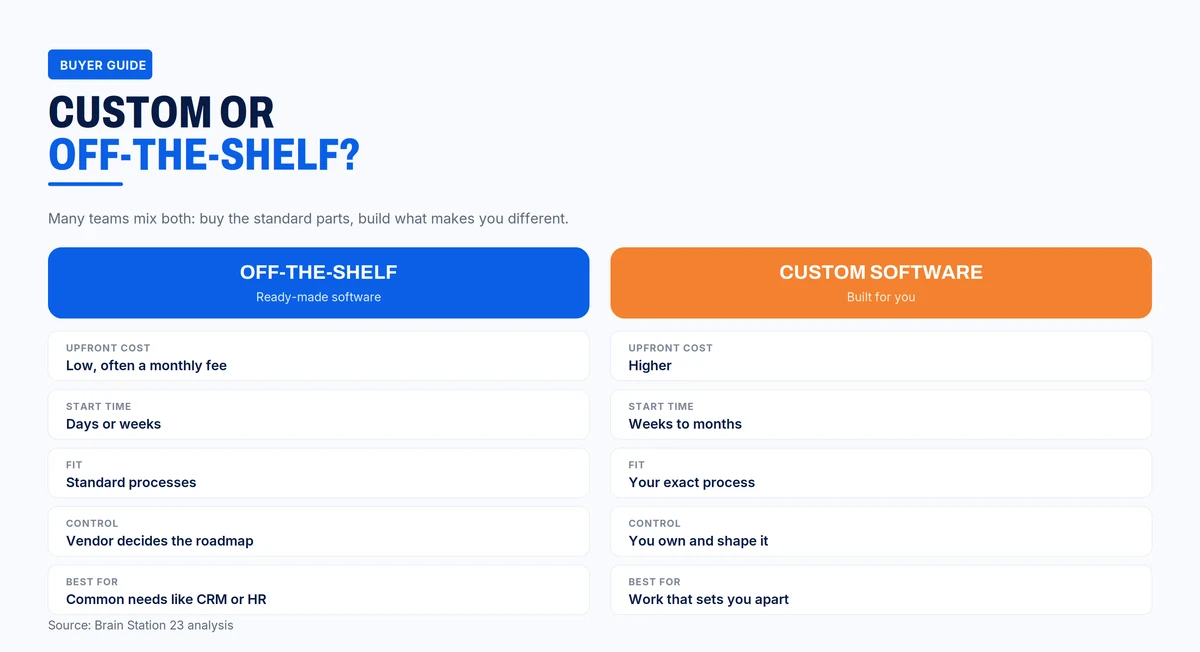
The right software type depends on your project. Plenty of teams pick wrong because they only look at the sticker price. Remember that “price” is just one of the many factors. So, here’s the comparison to help you decide.
When Off-the-Shelf Wins
Ready-made tools are cheaper upfront and quick to start. If your need is common and standard, buy, don’t build. No point coding a CRM from scratch when a great one already exists for a monthly fee.
When Custom Pays Off
Custom software development fits your idea and process from the first day of the project. As you build it from scratch, you can shape it to meet your needs and expectations.
That means, for doing something that is completely new to the world or if you want more control, a custom build wins over time. You own it; you shape it. So, your build always meets your needs and expectations.
The Middle Path Most Miss
Here’s what most people don’t realize. You don’t always choose one or the other. Many builds start with off-the-shelf parts, then add custom pieces where the standard tool falls short. Smart, and cheaper than a full rebuild.
Ask yourself one thing. Is this process a core part of how you beat rivals? If yes, build it. If no, buy it and spend your money where it actually counts.
Germany vs Other Software Development Destinations in Europe
You’re not really choosing a country. You’re choosing a delivery model. Onshore, nearshore, or offshore. Each has a real trade-off.

Onshore in Germany
A native German team gives you the tightest communication and the strongest local trust. You pay top rates for it. Best for sensitive, high-stakes builds where being in the same room matters most.
Nearshore Across Europe
Poland, Romania, the Czech Republic, and the wider region give you the same working day at a lower cost. Most firms on this list live here. It’s the sweet spot for a lot of German buyers, and for good reason.
Offshore Further Afield
Teams in Asia bring the lowest rates and huge talent pools. The trade is the time zone gap and more upfront coordination.
If you decide to outsource software development to an offshore team that works to German standards, pick a firm with strong process, clear reporting, and named references. Those three things close most of the distance.
A Quick Cost-and-Control Trade
So, select onshore for control and trust. Offshore for cost and scale. And nearshore sits in the middle. Your project’s risk level should decide which delivery model you choose.
So Which One?
To be honest, there’s no single answer. High-security work should look at onshore first. Cost-led builds may look at offshore. Most projects are best served by nearshore.
Why Businesses Outsource Software Development to Germany
When outsourcing is done right, it solves the exact problems German firms struggle with most.

The Talent Shortage
Germany is short around 79,000 IT specialists, and 78 percent of companies feel it. So even big firms can’t hire fast enough on their own. Outsourcing bridges that gap in days, not months. You borrow the skills you can’t recruit locally, and you keep your roadmap moving.
Speed to Market
An outside team can start next week, not next quarter. When a competitor is breathing down your neck, that head start is everything. You skip the whole hiring slog entirely. Just start your project whenever you want to.
Cost Without the Quality Drop
A good partner gives you senior engineers at a lower blended rate. You decide whether to hire a full team or a single specialist. And either way you get rid of the fixed cost of permanent staff.
Access to Skills You Can’t Hire Locally
Some skills are just scarce. Embedded engineers, ML specialists, SAP architects. A good outsourcing partner already has them on the bench. So you get niche expertise on day one, instead of hunting for it for half a year.
How to Choose the Right Software Development Company in Germany
You’ve got the list. Now comes the hard part. To be honest, the difference shows up in how they answer your questions. So here’s what to check before you sign anything.

Start with proof, not promises
Every company claims they are good. So how do you check? Just ask for some names of their existing clients, real case studies, and references you can call. If they hesitate, you get your answer instantly. Good firms are proud to show receipts.
Check the data and security story
Ask where your data lives, what certifications they hold, and how they handle GDPR. For any build tied to this market, this isn’t optional. A vague answer here is a red flag you can’t ignore.
Match the skills to your build
A great automotive-embedded team may be wrong for your e-commerce app. Line up their tech stack and past industries against your actual project. A famous name is not proof. A strong track record with projects like yours is.
Prep before you reach out
Here’s something most people skip. Write down your goal, your budget range, and your must-have features before the first call. The clearer you are, the sharper their quote comes back.
And you’ll spot a good partner fast. They’ll ask smart questions about your prep instead of just nodding along. That back-and-forth is a preview of the whole project.
Questions worth asking
Keep a few sharp, specific, outcome-based questions ready. Who owns the code? How do you handle handovers? What happens if a key developer leaves? The answers tell you how they’ll treat you when things get hard.
Watch how they communicate
Pay attention during the sales calls. Do they reply fast? Do they explain things plainly, or hide behind jargon? Communication in the pitch is the best preview you’ll get of communication during delivery. Trust that signal.
Free download
Take the vendor checklist with you
The questions to ask, a scoring sheet and the contract points to check. Free PDF.
Download my free checklistCommon Mistakes to Avoid When Hiring a Software Development Company
Most bad projects don’t fail from bad luck. They fail from the same handful of avoidable mistakes. Dodge these and you’re most of the way there.
Picking on Price Alone
The cheapest quote often costs the most in the end. Rework, delays, and a half-built product eat any savings. Weigh value, not just the number at the bottom of the invoice.
Skipping the Data Question
Plenty of buyers never ask where their data goes. Then a GDPR issue lands, and it’s their name on the fine. Don’t be that team. Ask early, ask clearly, get it in writing.
Vague Requirements
Fuzzy scope breeds fuzzy results. If you can’t explain what “done” looks like, neither can they. Nail the requirements before a single line of code gets written. So, your project’s success depends on how clearly you can explain your requirements.
No Code Ownership Check
This one bites hard. Some buyers finish a project and realize they don’t fully own the code or the docs. Sort ownership in the contract, upfront, in writing. Every time, no exception. Otherwise, you may end up building your software twice.
Ghosting the Project
Handing it over and vanishing is a classic error. The best builds come from teams that stay involved, review often, and give quick feedback. Stay in the loop, and the whole thing goes smoother.
Ignoring Post-Launch Support
Launch day isn’t the finish line. Bugs surface, users push back, and the thing needs care. Pick a partner who sticks around for maintenance, or you’ll be scrambling for a new one the moment something breaks.

Frequently Asked Questions
These are the questions German buyers ask us most often. Timelines, contracts, code ownership, data rules and cost. Here are short, honest answers.
How long does it take to build custom software?
A small MVP can take weeks. A full enterprise platform can take many months. The honest answer is that scope drives the clock, so lock your requirements early and ask for a phased timeline.
Should I sign a fixed-price contract or pay by the hour?
Fixed price works when the scope is locked and the build is small. Time and materials works better for anything that will change, which is most software. A safe middle path is a paid discovery phase first, then a fixed price on the part you both understand.
Who owns the code once the project ends?
You should, but only if the contract says so in writing. German copyright law gives the economic rights in software to the developer’s employer, which is usually your vendor, unless something else is agreed. So ask for a full transfer of exclusive usage rights before the first sprint starts.
Is it better to hire in Germany or outsource nearshore?
Neither wins outright. Onshore gives the tightest trust for sensitive work. Nearshore gives strong value with the same working day.
Are offshore developers reliable for German projects?
They can be, with the right firm. Strong process, clear reporting, and named references matter more than location. The gap to watch is time zone, so build in async check-ins and you’ll be fine.
Do German software development companies work in English?
Almost all of them do at the senior level. The catch is documentation, which sometimes stays in German. Ask for English tickets, English commit messages, and one English-speaking project manager on every call.
Do software development companies in Germany follow GDPR?
Serious ones do, and they treat it as basic hygiene. Under Article 83, a breach can cost up to 20 million euros or 4 percent of global turnover. Ask any candidate exactly where your data lives before you sign.
What happens after launch?
The work doesn’t stop. Budget for hosting, security patches, dependency updates, and small fixes, then agree on response times in a support contract. Get the warranty period in writing too, and don’t assume it stretches to cover new features.
How much does custom software cost in Germany?
It depends on the scope. One German source puts an MVP at €15,000 to €50,000, a medium business application at €50,000 to €150,000, and a complex platform at €150,000 or more. Most Mittelstand projects land between €40,000 and €120,000.
Final Thoughts
Choosing among the top software development companies in Germany really comes down to fit. A native German team, a nearshore partner, or an offshore shop, each earns its place for the right job.
So do the homework. Check the certificates, ask about data, and match the skills to your build.
The right partner won’t just write code. They’ll save you the mess a wrong one leaves behind.
Brain Station 23
Your next step
Ready to pick the right partner?
Tell us what you are building. In 30 minutes you will know the next step, the rough cost and who should build it, even if it is not us.
Book my free 30-minute call- 20+ years
- 900+ engineers
- 36+ countries
- CMMI Level 3
- ISO 27001
- SOC 2 Type II
Sources of Information
- Bitkom, Digitalbranche weiterhin stabil, July 2026: software, AI platform and cloud market figures (www.bitkom.org/Presse/Presseinformation/Digitalbranche-weiterhin-stabil)
- Bitkom, IT-Fachkräftemangel in den letzten drei Jahren halbiert, September 2026: IT skills gap (www.bitkom.org/Presse/Presseinformation/IT-Fachkraeftemangel-in-den-letzten-drei-Jahren-halbiert)
- Bitkom, Deutschland fehlen IT-Fachkräfte, 2025: time to fill an IT job (www.bitkom.org/Presse/Presseinformation/Deutschland-fehlen-IT-Fachkraefte)
- Bitkom, Datenschutz als Innovations-Bremse, May 2025: projects stopped over data protection (www.bitkom.org/Presse/Presseinformation/Datenschutz-Innovations-Bremse)
- Bitkom, Wirtschaftsschutz 2026, August 2026: damage from cyberattacks (www.bitkom.org/Presse/Presseinformation/Angriffe-auf-deutsche-Wirtschaft-Spur-auslaendische-Geheimdienste)
- Bitkom, Digitalwirtschaft bleibt Stabilitätsanker, January 2026: jobs in the digital industry (www.bitkom.org/Presse/Presseinformation/Digitalwirtschaft-bleibt-Stabilitaetsanker)
- GTAI, Information technologies in Germany: ITC market size (www.gtai.de/en/invest/industries/information-technologies)
- McKinsey and University of Oxford, Delivering large-scale IT projects on time, on budget, and on value (www.mckinsey.com/capabilities/mckinsey-digital/our-insights/delivering-large-scale-it-projects-on-time-on-budget-and-on-value)
- Stepstone, Senior-Software-Entwickler/in Gehalt (www.stepstone.de/gehalt/Senior-Software-Entwickler-in.html); freelancermap, Stundensatz Softwareentwickler (www.freelancermap.de/blog/stundensatz-softwareentwickler/); business.digital, Software entwickeln lassen: Kosten (business.digital/magazin/software-entwickeln-lassen-kosten)
- Accelerance, 2026 outsourcing rate trends (www.accelerance.com/blog/2026-outsourcing-rate-trends-asia-europe-latam); ECB, euro reference rates (www.ecb.europa.eu/stats/policy_and_exchange_rates/euro_reference_exchange_rates/html/eurofxref-graph-usd.en.html), 28 September 2026
- GDPR Article 83 (www.ecb.europa.eu/stats/policy_and_exchange_rates/euro_reference_exchange_rates/html/eurofxref-graph-usd.en.html); BFSG §37 (www.gesetze-im-internet.de/bfsg/__37.html); BSI on the NIS2 law (www.bsi.bund.de/DE/Service-Navi/Presse/Pressemitteilungen/Presse2025/251205_NIS-2-Umsetzungsgesetz_in_Kraft.html); BSIG §65; EU Cyber Resilience Act (digital-strategy.ec.europa.eu/en/policies/cyber-resilience-act); UrhG §69b (www.gesetze-im-internet.de/urhg/__69b.html)
- Company facts: each company’s own website, LinkedIn pages, partner directories and German company registers, checked on 29 September 2026
Get the Germany Software Vendor Evaluation Checklist
Enter your email and we will send you the PDF.