
 CyberStation CSIRT · Incident Case Study
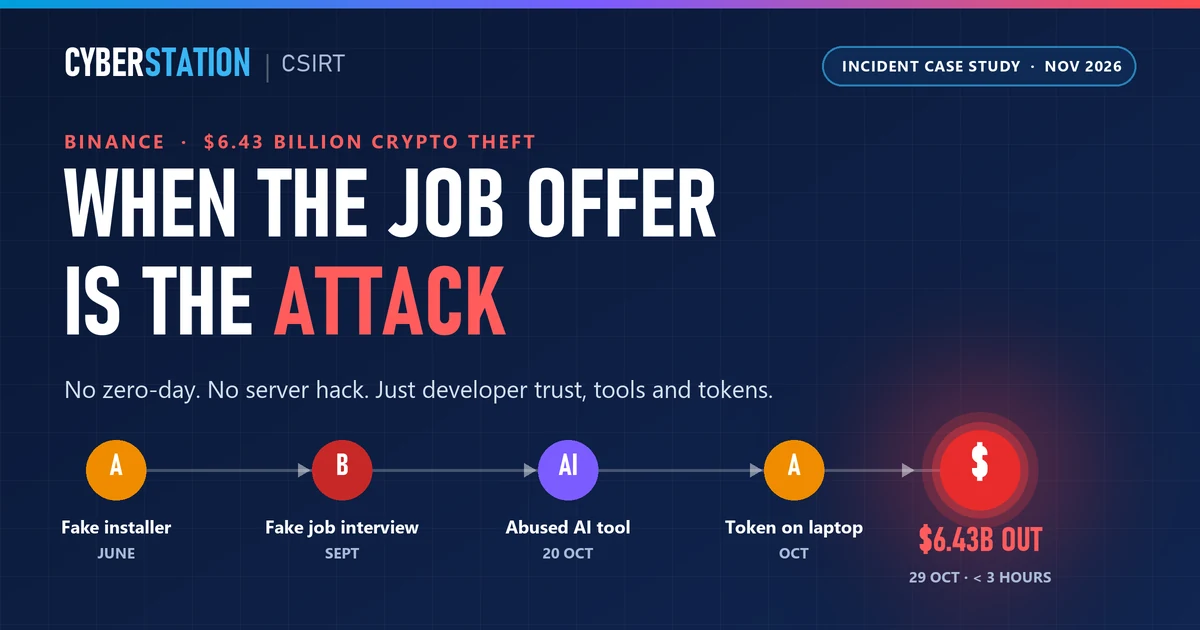
When the Job Offer Is the Attack: What Binance’s $6.43 Billion Breach Teaches Every Developer
No zero-day. No server hack. Attackers turned developer trust, tools and tokens into the largest exchange theft on record.
On 3 November 2026, Binance revealed how attackers stole $6.43 billion from the world’s largest cryptocurrency exchange. There was no zero-day exploit and no brute-force attack on its servers. The attackers went after developers: their laptops, their trust, and the tools they use every day.
Binance says the breach has been contained, affected systems rebuilt and entry points closed. The lesson does not end there. The same methods can be used against any software company.
How the attack unfolded
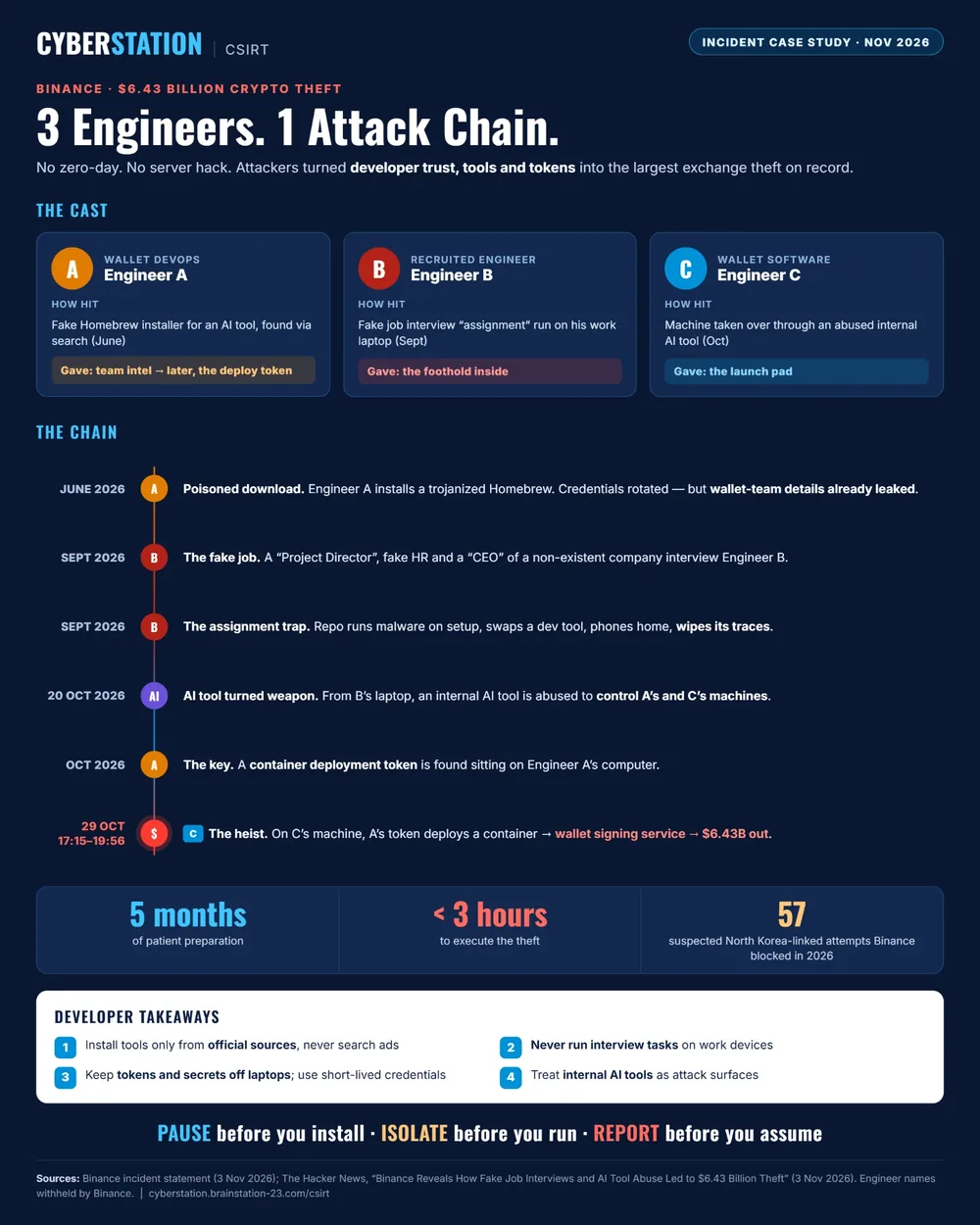
- 1June 2026A poisoned download
A DevOps engineer installed a popular AI tool using a fake Homebrew installer found via search. Binance rotated credentials, but the attacker had already learned who worked on the wallet team.
- 2Sept 2026A convincing job offer
Another engineer was approached on a legitimate job platform by a fake “Project Director”, then interviewed by a fake HR representative and the “CEO” of a non-existent company.
- 3Sept 2026The “assignment” trap
He was asked to run a coding assignment on his work computer. Malicious code replaced a developer tool, contacted the attacker’s server and erased its traces.
- 420 Oct 2026Internal AI tool abused
From that laptop, the attacker abused an internal AI tool to take control of other engineers’ machines.
- 5Oct 2026A token left on a laptop
A powerful container deployment token was found stored on one engineer’s workstation.
- 629 Oct 2026Theft in under 3 hours
Using that token, the attacker deployed a container, reached the wallet signing service and approved transactions outside the normal withdrawal process.
Five months of patience. Less than three hours to steal billions.
Why this matters to every developer
It is tempting to see this as a crypto-industry problem. It isn’t. Every step of the attack exploited ordinary developer habits:
- Searching for a tool and installing the first result.
- Taking a job interview task seriously and running it locally.
- Keeping access tokens on a laptop “for convenience”.
- Trusting internal tools completely.
None of these feel risky in the moment, which is why they work. Binance itself says it has blocked 57 suspected North Korea-linked attack attempts this year, using fake job interviews, malware disguised as developer tools, compromised packages and browser extensions, and fake video-call apps. These campaigns are organised, patient and constant.
Six habits that would have broken the chain
Install software only from official sources
Don’t install from search ads or unfamiliar links. Use the official website, package manager or BS23-approved repositories. If a download link looks “close enough”, treat it as suspicious.
Never run interview assignments on work devices
No genuine employer needs you to run unknown code on your company laptop. If you take part in any external assessment, use a personal, isolated environment, or decline. Be especially careful with repositories that run scripts automatically during
npm install,pip install, build or setup steps.Keep secrets off your laptop
Deployment tokens, cloud keys and production credentials should be short-lived and stored in approved secret managers, never in plain files, shell history or
.envfiles on your workstation. If a token on your laptop could deploy to production, an attacker who reaches your laptop can too.Question unusual trust-building
Attackers invest heavily in looking real: polished profiles, multiple interviewers, personal photos, urgency. A genuine opportunity survives a few verification checks. Confirm the company exists, check its domain, and be wary of interviews moving to chat apps.
Treat internal tools as attack surfaces
AI assistants, automation bots and internal platforms that can act across machines are powerful, and so is their misuse. Report anything unusual, such as unexpected actions, prompts or access requests.
Report early, even if it feels minor
Binance’s first warning came in June, months before the theft. A “small” suspicious install, a strange recruiter message or an unexpected login might be the first step of something much larger. Early reports cost nothing; late discovery can cost everything.
Cyber resilience is a team habit
Security tools matter, but this incident shows that attackers often succeed through people and processes. Detection, endpoint protection and access controls help, but each developer decides what to install, what to run and what to report.
The takeaway
Binance has rebuilt its systems and closed the doors the attackers used. But the playbook is public now, and it will be reused. Fake recruiters, poisoned tools and stolen tokens are not crypto problems. They are developer problems, and that means they are our problems too.
Pause before you install. Isolate before you run. Report before you assume.
Seen something suspicious? Report it early.
For security concerns or suspicious activity, contact CyberStation CSIRT. A strange recruiter message, an unexpected install or an odd login is worth a report.
Source: Binance incident disclosure, as reported by The Hacker News, 3 November 2026.
Frequently asked questions
How did the Binance hack happen?
The Binance hack was a social engineering attack, not a server breach. Over five months, attackers compromised three engineers through a fake Homebrew installer, a fake job interview with a malicious coding assignment, and an abused internal AI tool. A container deployment token left on one laptop let them reach the wallet signing service and move $6.43 billion in under three hours.
Was the Binance breach a supply chain attack?
Partly. The first step was a software supply chain attack: a trojanized installer for a popular AI tool. The decisive steps were social engineering and credential theft, which is why developer security awareness, not just tooling, is the lesson.
What is a fake job interview scam targeting developers?
Attackers, often linked to North Korean hacking groups, pose as recruiters or hiring managers on legitimate job platforms. They run convincing interviews and then send a “coding assignment” that installs malware when it is run. Binance says it blocked 57 such suspected North Korea-linked attempts in 2026.
What are the secure coding and secrets management practices that stop this?
Install tools only from official sources, never run external assessments on work devices, keep deployment tokens and cloud keys in a secret manager with short lifetimes, treat internal AI tools as attack surfaces, and report anything suspicious early.