
 CyberStation CSIRT · Security Insight
The Engine Behind 70% of the Web Just Cracked. Is Yours Patched?
A clear, jargon-free breakdown of the critical “PHP2Shell” vulnerabilities: what broke, who’s exposed, and the exact steps to stay safe.
On October 21, 2026, the PHP Security Team announced an emergency fix for two critical vulnerabilities in PHP; the standard coding language that quietly powers an estimated 70% of all websites. They are both listed as CVE-2026-109618 and CVE-2026-109619 and referred to as “PHP2Shell”, with a CVSS (Common Vulnerability Scoring System) v4.0 severity score of 9.2 (Critical). Details leaked before official release, and attacks were reported in the wild before the patch was even public.
It’s easy to read this as a distant, foreign headline, but it isn’t one. In Bangladesh, PHP powers a huge share of e-commerce platforms, government portals, news sites, and business applications. If your website runs on PHP, this is your problem too. As a private CSIRT (Computer Security Incident Response Team) committed to national cyber resilience, CyberStation issued an alert the same day, and are sharing this insight so that every website owner and administrator knows what happened and what to do.
What actually broke (in plain terms)
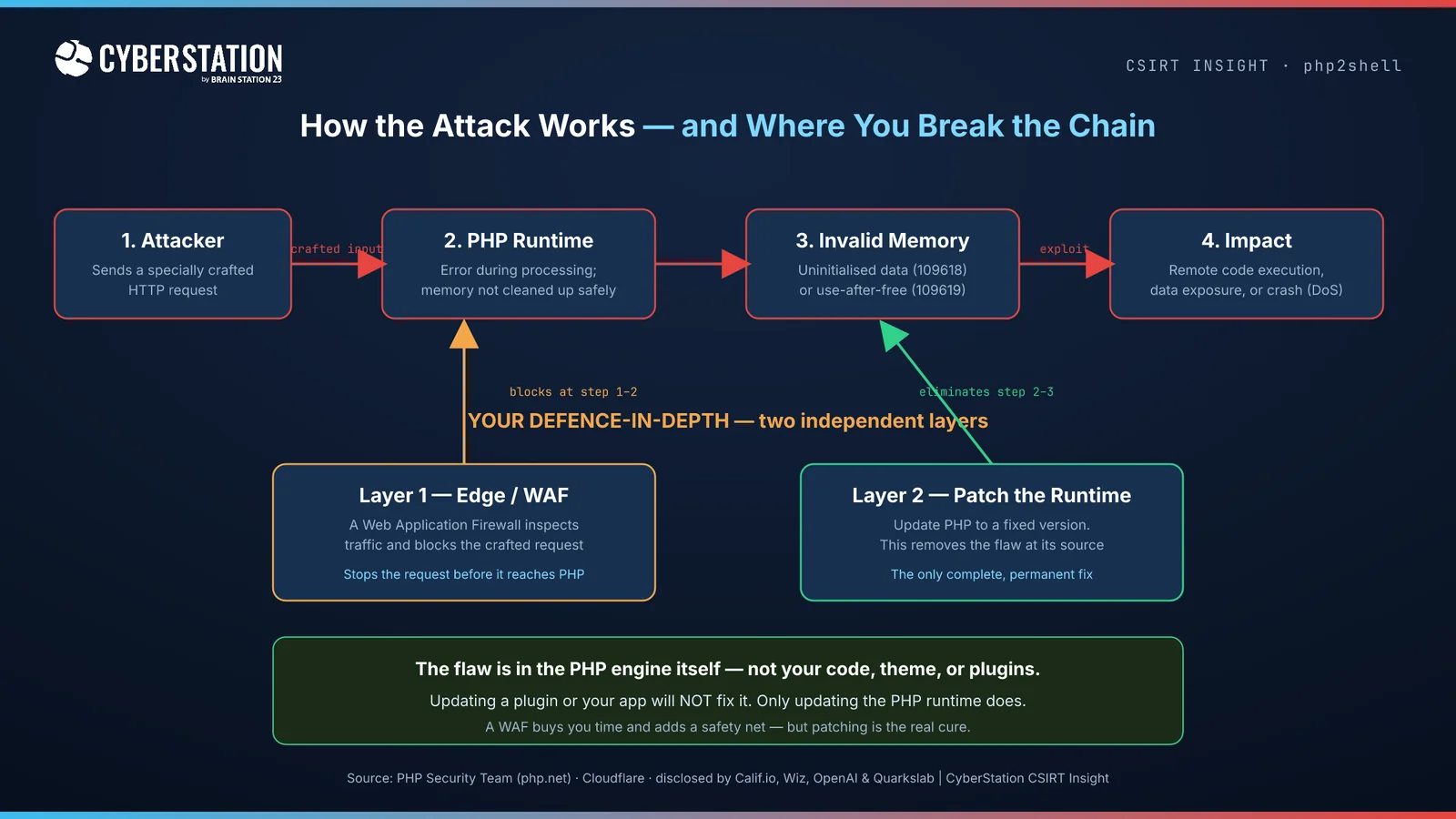
Both vulnerabilities are memory-handling bugs inside the PHP engine itself. Normally, when PHP is doing a web request, it uses a small amount of memory to do its work and then gets rid of it afterward. The trouble starts when something goes wrong in the middle of a request. PHP doesn’t release that memory safely. It can then accidentally reuse data that was never properly initialized, or memory it had already let go of.
An attacker can trigger this on purpose by sending a crafted web request. The two bugs are similar. The only difference is when the unsafe memory gets used:
PHP runs out of memory, stops early and later uses internal data that was never fully initialized.
When a request ends abnormally (for example, after a fatal error), some of PHP’s internal state can outlive the memory behind it. A later request handled by the same PHP worker can pick up that stale state before it’s reset. This kind of flaw is called a “use-after-free.”
An attacker exploiting these bugs can cause any of three outcomes:
A full server takeover.
Sensitive information leaks out.
The site goes down.
Most importantly, no password or login is needed to attempt any of these.
The attack flow and where you break the chain
Why this is a big deal
This bug lives in the PHP runtime itself, not in any one app. That means anything running on a vulnerable PHP version could be exposed, including:
- WordPress
- Laravel
- Magento
- Drupal
- Joomla
- Countless custom-built systems
The uncomfortable truth: updating your website’s theme, plugins, or application code will NOT fix this. The vulnerability is in PHP itself. Only updating the PHP runtime or having your hosting provider do it closes the hole.
Who is affected
Reportedly, every PHP installation that serves web requests is at risk, and the flaws reportedly reach back to PHP 5. Because PHP is so widely used for websites and applications, the safest approach is simple: assume you’re in scope until you’ve confirmed you’re not.
Do this immediately
- Update PHP to a fixed version now
The official fixed versions are PHP 8.5.12, 8.4.27, 8.3.36, and 8.2.35.
- Take inventory of everything that runs PHP
List your websites, APIs, and internal tools. Patch internet-facing systems first.
- On managed hosting? Don’t assume you’re covered
Contact your provider today and confirm that the PHP security update has been applied.
- Still on end-of-life PHP (5.x or 7.x)
No official release is coming for these versions. Check whether your Linux distribution or LTS vendor offers a backported fix, or upgrade to a supported branch urgently. Isolate those systems until then.
- Add a safety net while you patch
A Web Application Firewall (WAF) can block exploit attempts at the edge while you roll out updates. Treat it as defense-in-depth, not a replacement for the update.
Note: Temporary mitigations (such as limiting upload sizes or adjusting php.ini settings) reduce exposure, but DO NOT offer complete protection. The only real solution is to patch the runtime.
After patching, don’t stop there
Updating PHP shuts the door. A resilient organization also checks whether anyone walked through it before the lock was fixed.
- Verify the fix: Check the running PHP version on every server, not just the ones you remember.
- Hunt for signs of compromise: Review server and access logs for unusual requests, unexpected files, or new processes around the disclosure window (mid-to-late October 2026).
- Run a focused security audit or VAPT: Confirm that no web shell, backdoor, or unauthorized change has been left behind.
- Rotate your secrets: If there’s any sign of exposure, rotate credentials, API keys, and database passwords.
- Make it a habit: Keep a living inventory of your tech stack, subscribe to vendor advisories, and decide who patches what, and how fast.
The bigger lesson: resilience over reaction
php2shell is a reminder that a single dependency buried deep in your stack can put an entire business at risk overnight. The organizations that survive these events aren’t the ones that react fastest to the news – they are the ones that were already prepared: they know what they run, they watch for threats constantly, and they patch with discipline.
That’s where CyberStation can help organizations get to, before the next advisory, not after.
Close the exposure. Don’t assume it.
Our CSIRT is Brain Station 23’s cybersecurity wing. We help enterprises find vulnerable assets, patch safely, hunt for compromise, and establish 24/7 monitoring and VAPT so exposure is closed, not assumed.
Sources & further reading
- PHP Security Team official advisory — php.net/archive/2026.php#2026-10-21-5
- Cloudflare — Cloudflare deploys protections against php2shell
- BBC News coverage of the PHP security disclosure
- Disclosed by Calif.io, Wiz, OpenAI & Quarkslab, coordinated with the PHP Foundation
This insight is published by CyberStation CSIRT for awareness. Verify version numbers and advisories against official PHP sources before acting. © 2026 CyberStation — Brain Station 23 PLC. All rights reserved.