

Healthcare · IoT Remote Monitoring
Ending the 2 a.m. Diaper Check: Sensors That Tell the Nurse Instead
Project Snapshot
- Client : DignaCare, a smart sensor solution for elderly incontinence care
- Industry : Healthcare and elderly care homes
- Scope : Complete software ecosystem — backend, nurse mobile app and admin web portal
- Platforms : Web and mobile (iOS and Android)
- Technologies : Azure, .NET, Node.js, AngularJS, Flutter
- Hardware : Sensor strip on the outside of the diaper, reading humidity and temperature
The Impact
Real time
Nurses notified the moment a patient needs supervision or a change
48-hour
History per sensor, so care follows each resident’s pattern
Fewer
Manual checks, preserving sleep and dignity
Less waste
Diapers changed when needed, not too early or too late
Overview
Incontinence care in a care home has always run on physical checks: a caregiver opens the door, wakes the resident, and looks. It is intrusive for the person and expensive for the home, and it is wrong in both directions — too early wastes supplies, too late means a soiled bed. DignaCare set out to replace the check with a signal, for three groups at once:
- residents, whose sleep and dignity should not depend on a schedule,
- nurses, who need to know which of many patients needs them now, and
- care-home operators, paying for supplies, laundry and labour that timing could reduce.
The hardware is deliberately simple: a strip on the outside of the diaper that reads humidity and temperature. What makes it care rather than data is everything that happens after the reading.
Brain Station 23 partnered with DignaCare to build that everything — the backend that receives and analyses sensor data, the Flutter app that notifies nurses in real time, and the web portal administrators use to run the whole estate.
The result changes the question a caregiver asks from “should I go and check?” to “the app says room 12, now.”
Business Challenges
Every problem here is a timing problem. The sensor solves none of them on its own; it only makes them solvable if the software turns a reading into the right notification to the right person.
Five pressures shaped the platform.
- Manual monitoring was inefficient and intrusive. Caregivers had to physically check residents frequently, disturbing sleep and dignity.
- Supplies were wasted. Diapers were often changed too early, wasting product, or too late, causing leakage.
- Late changes cost more than diapers. Soiled beds and surroundings drove up laundry frequency and labour.
- There was no data to plan care around. Homes lacked historical information to understand individual patterns and optimise schedules.
- Hardware had to become a notification. A robust system was needed to translate raw sensor data reliably into instant, easy-to-understand alerts for nurses.
The last one is the engineering problem. A missed or delayed notification is not a bug in this context; it is the failure the whole product exists to prevent.
Hardware that works, software that does not exist yet?
Bring it to a 30-minute call — we will come back with an architecture and a scoped estimate.
What We Built
The build follows the path of a single reading: sensed on the strip, received and analysed in the cloud, shown as a colour on a nurse’s phone, and kept as history the home can plan around.
An IoT sensor ecosystem
Sensor strips monitor humidity and temperature in real time to detect saturation, feeding a continuous signal instead of a periodic guess.
A real-time nurse app
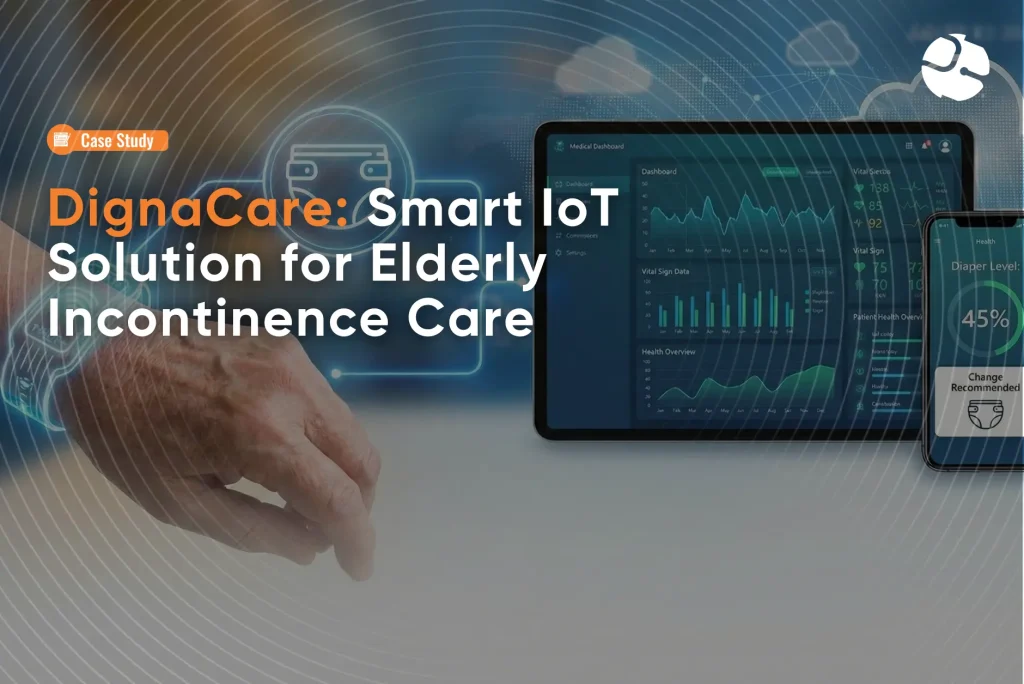
A Flutter mobile app notifies nurses immediately when a resident needs supervision or a change, and lets one nurse watch many residents from a phone.
Colour-coded status at a glance
Green for dry, yellow for moisture detected, red for saturated, white for sensor offline and grey for not activated — status readable in a second, at night, by someone in a hurry.
Historical insight
Each sensor links to a 48-hour graph, so caregivers can see a resident’s pattern and plan care around it rather than around a fixed rota.
A centralised web portal
Administrators oversee all sensors, gateways and users from one place, and connect with business partners for resource sharing.
A scalable backend
Azure, .NET and Node.js handle the influx of sensor data and make notification delivery reliable, which is the property the entire service depends on.
The Results
The outcomes read as care outcomes first and cost outcomes second, and in this product the two are the same decision made at the right time.
Dignity and timing
Unnecessary manual checks are reduced and changes happen when they are needed, improving comfort and hygiene for residents who no longer have to be woken to be checked. Nurses monitor multiple residents simultaneously from their phones, which changes how a shift is organised.
Cost and evidence
Changing diapers only when necessary prevents overuse, and timely notifications prevent leaks — significantly reducing bed-linen changes and the labour behind them. The 48-hour history gives care homes the analytics to allocate resources and raise the standard of care on evidence rather than habit.
The transferable lesson is that in IoT the sensor is rarely the product. Here the strip is trivial; the value is a notification pipeline reliable enough that a nurse can stop checking and trust the phone.
The five-colour status is worth copying anywhere. It encodes not just the patient’s state but the sensor’s — offline and not-activated are distinct colours — so a nurse never mistakes silence for “dry.”
Building a care or monitoring product around a sensor?
You might have hardware that works and no software behind it, alerts that are not reliable enough to act on, or data with no history to plan from. In every case, the first step is the same.
Book a 30-minute call with Brain Station 23. Bring your device and the workflow it needs to fit into, and we will come back with a proposed architecture, a delivery plan and a scoped estimate.
Hardware that works, software that does not exist yet?
Bring it to a 30-minute call — we will come back with an architecture and a scoped estimate.
Related Case Studies


