Oil & Gas · Digital Twin
A Week of Well Analysis, Answered in a Minute
Project Snapshot
- Client : GiologiQ, an advanced platform for oil and gas well engineering
- Industry : Oil and gas
- Scope : Digital twin, 3D visualization, AI insight engine, risk simulation and training
- Platforms : Web and desktop
- Technologies : Unity, .NET, Azure Functions, Azure Cosmos DB, Angular, GitHub Copilot, Aikido
- Headline result : Engineering analysis reduced from a week to a minute
The Impact
1 week → 1 min
Engineering analysis time, from manual interpretation to a queryable model
12M+ NOK
Saved per well by avoiding drilling mistakes
0%
Guesswork, with decisions made against precise digital twin insight
Multi-well
Large datasets held without losing rendering performance
Overview
Well engineering runs on documents. Drilling reports, logs and spreadsheets accumulate across wells and years, and the knowledge inside them is real but unreachable at the speed decisions are made. GiologiQ set out to change that for three groups:
- engineers, who were spending days assembling a picture from fragments,
- drilling teams, who needed hazards identified before an operation started, and
- new joiners, learning a complex domain without a safe place to practise.
The cost of the old way is not only time. A drilling mistake is expensive in a way that a reporting delay is not, and poor foresight is how those mistakes happen — which makes speed of analysis a safety property, not a convenience.
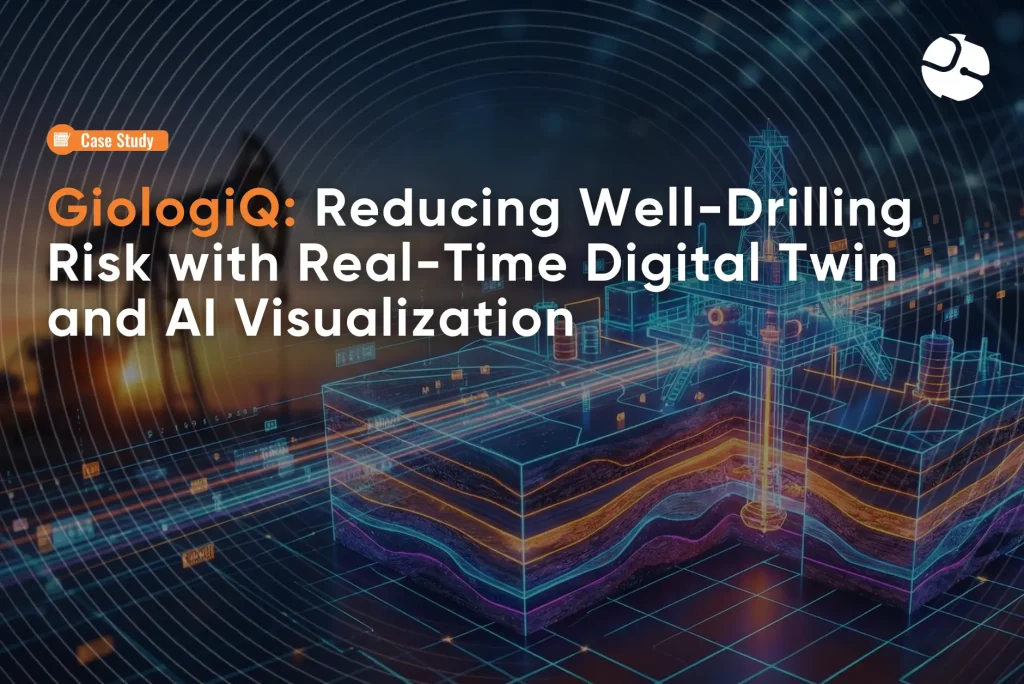
Brain Station 23 partnered with GiologiQ to build a unified digital twin: high-performance 3D visualization over a centralized operational model, with AI-accelerated insight on top.
Fragmented documents became one model engineers can explore, interrogate and simulate against — which is what takes a week of interpretation down to a minute.
Business Challenges
Every constraint here traces back to the same thing: the data existed, and nothing could read it fast enough to be useful while a decision was still open.
Five pressures shaped the platform.
- Analysis took days. Engineering teams manually worked through fragmented data spread across PDFs, logs and spreadsheets.
- There was no unified view. Without unified visualization, understanding complex well structures was slow and error-prone.
- Drilling mistakes were expensive. Poor real-time foresight and no hazard simulation left a high risk of costly errors.
- Decisions waited on preparation. Complex data preparation and manual reporting cycles delayed operational decisions.
- Scale threatened performance. The platform had to hold large, multi-well datasets while keeping rendering fast enough to explore interactively.
The last one is the engineering constraint that shapes the rest: a digital twin nobody can navigate smoothly is just a slower document.
Expertise locked inside PDFs and logs?
Bring it to a 30-minute call — we will come back with an architecture and a scoped estimate.
What We Built
The platform consolidates first, makes the model explorable second, and only then applies AI — so the intelligence sits on data that has already been structured rather than guessing at documents.
A centralized digital twin
All drilling data is combined into one unified operational model, replacing scattered reports with a single representation of the well.
Interactive 3D visualization
Engineers explore wellbores, depth structures and geological relationships directly, built on Unity for the rendering performance large multi-well datasets demand.
Automated contextualization
Unstructured drilling reports are transformed into structured insight, which is the step that makes everything downstream possible.
An AI insight engine
Fast summaries and filtered drilling intelligence compress what used to be days of reading into a query, without removing the engineer from the decision.
Risk simulation
Potential hazards are identified before operations begin, moving foresight ahead of the drill rather than into the post-mortem.
Predictive analysis and anomaly detection
AI summaries and anomaly detection accelerate engineering decisions by surfacing what does not fit, rather than waiting for someone to notice it.
A training module on real well data
New engineers learn hands-on against real wells, which shortens onboarding in a domain where experience is normally bought through years on the job.
The Results
The gains show up in analysis time, in avoided cost, and in how early a drilling team knows what it is about to hit.
Speed and cost avoided
Engineering analysis fell from roughly one week to one minute, and GiologiQ reports over 12 million NOK saved per well by avoiding drilling mistakes. The second figure is a consequence of the first: foresight that arrives after the decision has no value, and foresight that arrives in a minute changes what gets drilled.
Confidence and lower overhead
Precise digital twin insight removes the guesswork from interpretation, while faster risk foresight improves decision-making ahead of operations. Engineering overhead and manual interpretation effort both drop, and operational delays across drilling teams shrink because decisions no longer wait on data preparation.
The transferable pattern is the order of work. The AI is the visible part, but it only pays off because contextualization ran first — unstructured reports were turned into structure before anything tried to reason over them.
The training module is the quiet compounding piece. A digital twin built for analysis turns out to be the safest place to learn a job where mistakes cost twelve million kroner.
Sitting on operational data your teams cannot read fast enough?
You might have expertise locked in PDFs and logs, decisions waiting on manual preparation, or risk you only see after the fact. In every case, the first step is the same.
Book a 30-minute call with Brain Station 23. Bring your data sources and the decision they are supposed to inform, and we will come back with a proposed architecture, a delivery plan and a scoped estimate.
Expertise locked inside PDFs and logs?
Bring it to a 30-minute call — we will come back with an architecture and a scoped estimate.
Related Case Studies