

Telecom · Adobe Experience Manager
A B2B Order Channel That Did Not Exist, Now Carrying £50M a Year
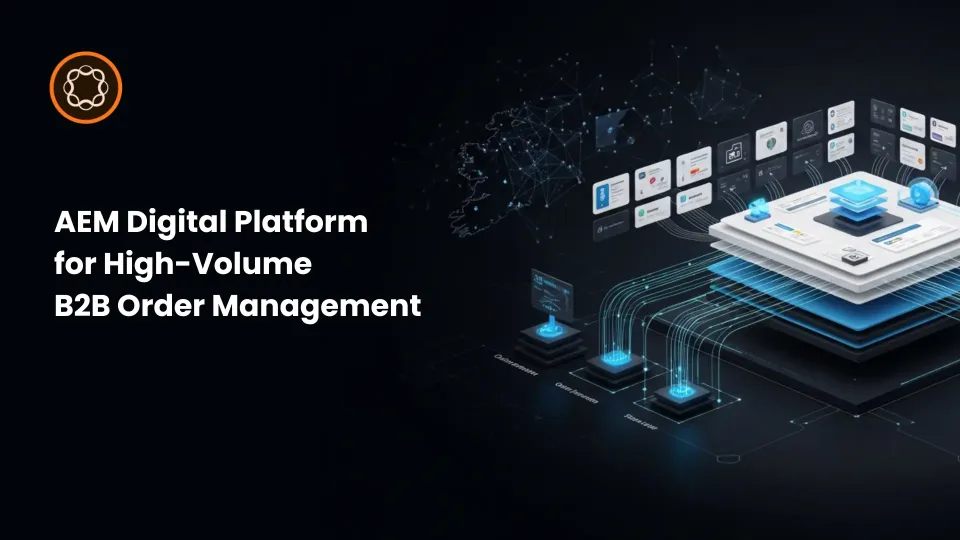
Project Snapshot
- Client : Global leader in broadband, mobile and IT services for business customers
- Industry : Telecom
- Scope : B2B customer-facing website, self-service portal and end-to-end order journey
- Markets : United Kingdom and Ireland
- Platforms : Web
- Technologies : Adobe Experience Manager, Adobe Experience Cloud
The Impact
£50M
Annual order volume processed through the platform that was built
Self-serve
Business customers manage their own service journey instead of calling an account team
End to end
Order journey managed digitally from browsing through to fulfilment
Integrated
Connected to the existing enterprise backend rather than sitting beside it
Overview
A global broadband, mobile and IT services provider sold to business customers across the UK and Ireland, and had no B2B website for them to buy through. Three groups were affected by that gap:
- business customers, who had no way to place an order online,
- account and service teams, absorbing by hand what a portal should handle, and
- fulfilment, which received orders through channels never designed to carry them.
Building a storefront is the easy half of this. The hard half is that a B2B order in telecom is not a checkout — it is a journey with stages, approvals and a fulfilment system waiting on the other side, and the digital channel is only useful if it carries all of that.
Brain Station 23 designed and implemented the customer-facing website and self-service portal on Adobe Experience Manager, with the full order journey integrated into the existing backend systems.
The platform now carries roughly £50M of order volume a year through a channel the business previously did not have at all.
Business Challenges
When there is no existing channel, there is also no existing shape to copy. Everything has to be decided: what a customer can do alone, what the system does next, and where the order lands.
Four pressures shaped the build.
- There was no B2B customer-facing website. The starting point was not a platform to improve but a channel that did not exist.
- Business customers needed to order online. Placing an order had to be something a customer could complete themselves, not a request routed through an account team.
- The order journey is high volume and multi-stage. Managing it digitally meant handling the whole journey, not just the moment of purchase.
- Fulfilment already had systems. The platform had to integrate with existing backend fulfilment rather than create a second, parallel record of what customers had ordered.
The last point is what separates a B2B portal from a brochure: if the order does not reach fulfilment cleanly, the digital channel has moved the work rather than removed it.
Orders still arriving through account managers?
Bring it to a 30-minute call — we will come back with an architecture and a scoped estimate.
What We Built
The build gives business customers a route they can complete on their own, and gives the organisation an order that arrives where it is needed in the form it is needed.
A B2B customer-facing website
A commercial front door built on Adobe Experience Manager, where business customers can browse products and services rather than requesting information about them.
Online order placement
Customers place orders directly, which converts a sales interaction that previously required a person into one the customer can complete when it suits them.
End-to-end order journey management
The platform manages the journey through its stages rather than only capturing a purchase, which is what makes it usable for high-volume B2B ordering.
Backend fulfilment integration
Integration with the existing enterprise systems means orders flow into fulfilment directly, keeping one record of what was ordered instead of two that have to be reconciled.
A self-service portal
Beyond the sale, business customers manage their own services through a centralised portal, reducing the routine service load carried by account teams.
The Results
The measure here is straightforward: a channel that did not exist now carries a material share of the business.
A commercial channel that carries real volume
The platform processes orders generating around £50M of order volume annually. Because customers place and manage orders themselves, demand that previously had to pass through account and service teams is now absorbed by the platform, which is what makes volume at this level sustainable rather than simply visible.
An order that reaches fulfilment intact
End-to-end journey management with backend integration means an order placed online arrives in the enterprise fulfilment systems without manual re-entry, keeping a single record from browse to delivery. The self-service portal extends that beyond the sale, so the customer relationship continues in the same place it started, across both the UK and Ireland.
The transferable lesson is about scope. It would have been faster to ship a catalogue and a contact form, and it would have moved no volume, because in B2B the value sits in the part after the order.
Integrating with the existing fulfilment estate rather than building beside it is the decision that makes the £50M real: an order the business has to re-key is not a digital order.
Selling to business customers with no channel they can use alone?
You might have orders arriving through account managers, a portal that stops at the purchase, or fulfilment systems nobody wants to integrate with. In every case, the first step is the same.
Book a 30-minute call with Brain Station 23. Bring your order journey and the backend it has to reach, and we will come back with a proposed architecture, a delivery plan and a scoped estimate.
Orders still arriving through account managers?
Bring it to a 30-minute call — we will come back with an architecture and a scoped estimate.
Related Case Studies

ERP
Centralizing AI-Driven Retail: How Kirei BD Scaled Operations with Odoo ERP Integration
