EdTech · Career Guidance Platform
A Career Platform Built for Four Kinds of User, From an Empty Repository to MVP
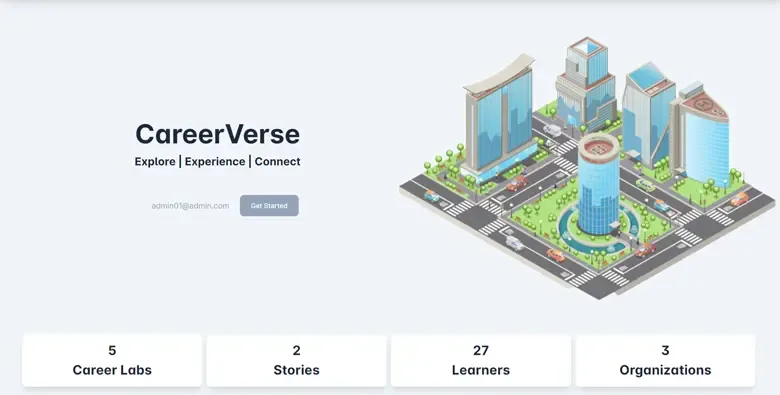
Project Snapshot
- Client : Career Verse, a career advising and exploration platform
- Industry : EdTech and career guidance
- Scope : Greenfield MVP — multi-role platform for learners, organisations, authors and administrators
- Platforms : Web
- Technologies : Angular, Laravel, MySQL, AWS
- Content model : Places, stories, career paths, labs and modules, tied together by career-path metatags
The Impact
4 roles
Learner, organisation, author and super admin, each with its own workflow
Greenfield
Built from the ground up as a minimum viable product
Reviewed
Every organisation and every piece of content approved before it goes live
Portfolio
Completed career labs added automatically to the learner’s record
Overview
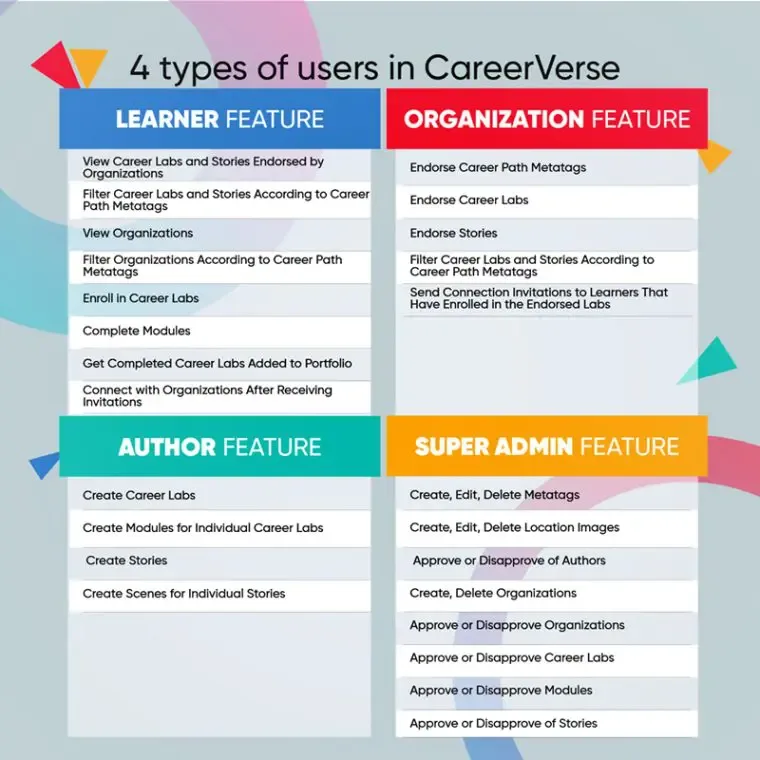
Career Verse set out to be the place where someone who does not yet know what they want to do can find out — through real stories, guided labs and organisations willing to show what a job actually looks like. That requires serving four groups whose needs barely overlap:
- learners exploring careers and building a portfolio as they go,
- organisations that provide content and want to reach the learners it attracts,
- authors who write the labs, modules and stories the platform runs on, and
- administrators responsible for keeping all of it trustworthy.
There was nothing to build on. The platform had to be created from the ground up, and the hardest part of a greenfield multi-sided product is not any single feature — it is making the roles fit together so that one side’s output is another side’s input.
Brain Station 23 designed and delivered the MVP: a role-based platform where organisations create Places, authors create labs and stories, learners explore and enrol, and a super admin approves what reaches the public.
The result is a working marketplace of career knowledge, with personalised recommendations, a unified learner dashboard, and a review gate that keeps the content honest.
Business Challenges
A career-guidance platform is only as good as the trust a learner can place in it. Every design decision below is about earning that trust while still giving four different kinds of user something worth logging in for.
Five pressures shaped the MVP.
- It was a blank page. Career Verse was creating a comprehensive career-advising platform from nothing, for both users and organisations at once.
- Four roles had to coexist. Learners, organisations, authors and administrators each needed their own permissions, workflows and views of the same content.
- Organisations had to be verifiable. Content providers needed to prove authenticity and route communication through a named point of contact before they could publish anything.
- Content needed a gate. Places, stories, paths and labs submitted by organisations could not go live without review, or the platform’s credibility would go with them.
- Discovery had to be personal. A learner facing hundreds of paths needs categorised, metadata-driven search and recommendations, not a list.
Underneath all five is one architectural requirement: a content model — Places, stories, paths, labs, modules, metatags — shared by every role but controlled differently by each.
Four kinds of user, one blank repository?
Bring it to a 30-minute call — we will come back with an architecture and a scoped estimate.
What We Built
The MVP is organised around its roles. Each one gets the tools its job needs, and the content model underneath is what lets their work connect.
Verified organisation accounts
Organisations sign up with verifiable information such as their website and a designated point of contact, who then acts on the organisation’s behalf.
Places and the content around them
Organisations create, manage and update Places representing professional spaces, and attach stories, paths, labs and metadata to give them depth.
Author tooling for labs and stories
Authors craft Career Labs, modules, stories and scenes — the educational material the whole platform runs on.
The learner experience
Learners register, explore Places, stories, paths and labs, and use the Career Related Data Set (CARDS) for insight into different career aspects.
Discovery and recommendation
Categorisation and metadata-based search make content findable, and the system generates personalised recommendations from each learner’s interests and interactions.
A unified learner dashboard
Learners track everything they have explored and their ongoing progress in one place, with completed labs added to their portfolio.
Super admin control and the review gate
Full user management across roles, control of content and metadata, and the authority to approve or reject organisation submissions before they go live.
The Results
The MVP delivers value on both sides of the marketplace — for the individual choosing a path, and for the employers and economy waiting at the other end of it.
Guidance that changes decisions
Structured career guidance gives individuals clarity about their strengths, interests and values, so they can align aspirations with practical steps. That reduces the likelihood of mismatched or unfulfilling career choices and supports continuous growth in a job market that keeps changing.
A pipeline of prepared talent
Companies gain access to motivated fresh talent who arrive with relevant skills and a clear sense of their role, which shortens onboarding. More broadly, training aligned with in-demand areas narrows the gap between industry requirements and available talent and helps build a workforce that stays adaptable.
The transferable lesson is about multi-sided products: the roles are the architecture. Deciding what a learner, an organisation, an author and an admin can each do to the same Place is most of the design, and the feature list follows from it.
The review gate is the detail worth keeping. Letting organisations publish freely would have been faster to build and would have cost the platform the one thing a career-guidance product cannot afford to lose.
Building a platform where several kinds of user share one body of content?
You might be starting from nothing, working out how roles and permissions fit together, or trying to keep user-generated content trustworthy. In every case, the first step is the same.
Book a 30-minute call with Brain Station 23. Bring your user types and what each of them needs to do, and we will come back with a proposed architecture, a delivery plan and a scoped estimate.
Four kinds of user, one blank repository?
Bring it to a 30-minute call — we will come back with an architecture and a scoped estimate.
Related Case Studies